


- Interval International is replacing its Unit-Size Upgrade program with a new feature called Uptrade, effective October 3, 2026.
- Uptrade assigns numerical Trading Power to deposited weeks and Exchange Value to requested vacations, based on resort quality, unit size, travel season, and demand.
- Members can exchange up to two Exchange Value points above their Trading Power at no extra cost. Beyond that, upgrade fees range from $99 to $599.
- The standard full-week exchange fee is also increasing from $249 to $264 on the same date.
- Flexchange Confirmations are exempt from Uptrade fees, but the Flexchange window was shortened from 59 to 30 days before check-in in 2025.
- E-Plus retrade rules change under Uptrade: paying an upgrade fee once does not guarantee fee-free access during subsequent retrades.
- Lower-Trading-Power owners gain new access to higher-value inventory. Higher-Trading-Power owners may face increased competition for the same inventory.
- The most cost-effective long-term strategy remains owning a high-quality, high-demand week purchased on the resale market.
Interval International is preparing one of the most consequential changes to its weeks-based exchange system in recent memory. As an experienced timeshare resale broker who has watched Interval adjust its policies for years, our team sees these changes as deserving close attention, because it touches nearly every member who deposits a week and searches for an exchange.
Below, we’ll walk through exactly what Interval has published about Uptrade, how it replaces the current Unit-Size Upgrade program, what the new fee structure looks like, and who stands to benefit most from the change. I’ll also flag a few practical wrinkles that weeks owners should watch for once the new system goes live.
What Is Uptrade and What Else Is Changing on October 3, 2026?
Interval International has told members that Uptrade is an evolution of its existing Unit-Size Upgrade feature. That description undersells how much is actually changing. The current program is narrowly focused on villa size. Uptrade expands the calculation to include resort quality tier, travel season, and demand, alongside unit size.
In its member communication, Interval explained the shift this way:
This new feature is an evolution of unit-size upgrade, which will be discontinued in its current form. Now, you will have access to a broader range of vacation opportunities across the Interval network with additional unit sizes, travel dates, destinations, and resorts.
Interval InternationalInterval also confirmed that members will have a choice under the new system: exchange into comparable inventory for no additional fee, or pay an upgrade fee to access inventory Interval considers more valuable.
Uptrade-Specific Terms
A few familiar and new terms have been posted on Interval’s Uptrade page in order to get users familiar with the verbiage that will be used by the new system.
Trading Power
The value assigned to your deposited week based on resort quality (as reflected by the Resort Recognition tier), unit size, travel season, demand, and the date of your deposit.
Exchange Value
The value of the requested unit week based on resort quality (as reflected by the Resort Recognition tier), unit size, travel season, and demand for such unit week.
Uptrade
An exchange to a higher-value stay. This new feature applies to weeks-owning members only, allowing them to explore more unit sizes, travel dates, and destinations.
Standard Full-Week Exchange Fee
Uptrade is not the only change taking effect on October 3, 2026. Interval’s updated fee schedule also raises the standard full-week exchange fee from $249 to $264, an increase of about 6%. This is Interval’s first exchange fee increase since 2023, and it applies regardless of whether a member uses the new Uptrade system or not.
You can see the all of the up-to-date Interval International fees here: Interval International Fees: A Comprehensive Guide For Timeshare Owners.
How Uptrade Replaces the Unit-Size Upgrade Program
To understand why Uptrade represents such a significant shift, it helps to look at how the current system works.
Under the previous Unit-Size Upgrade program, Interval charges a flat step-up fee for each increase in villa size.
Studio
- to One Bedroom – $99 (One step up)
- to Two Bedroom – $198 (Two steps up)
- to Three Bedroom – $297 (Three steps up)
- to Four Bedroom – $396 (Four steps up)
One Bedroom
- to Two Bedroom – $99 (One Step Up)
- to Three Bedroom – $198 (Two steps up)
- to Four Bedroom – $297 (Three steps up)
Two Bedroom
- to Three Bedroom – $99 (One Step Up)
- to Four Bedroom – $198 (Two steps up)
Three Bedroom
- to Four Bedroom – $99 (One Step Up)
Gold and Platinum Membership Discounts for Upgrades
- Gold Membership: Provided a $20 discount per step-up.
- Platinum Membership: Offered a $40 discount per step-up.
How The New Uptrade System Values Deposits
Uptrade discards that step-based model entirely in favor of two numerical figures:
- Trading Power, assigned to the week a member deposits
- Exchange Value, assigned to the vacation a member is trying to obtain
Both figures are calculated using resort quality (measured through Interval’s Resort Recognition tier), unit size, travel season, and demand. Trading Power includes one additional factor that Exchange Value does not: the date on which the member deposits the week. Depositing early has always mattered for Interval trading power, and that principle carries forward under Uptrade.
Published Exchange Value Ranges by Resort Recognition and Unit Size
Interval’s updated Buyers’ Guide includes actual Exchange Value ranges based on Resort Recognition tier and unit size. Here is how those ranges break down:
| Resort Recognition | Studio | 1 Bedroom | 2 Bedroom | 3 Bedroom | 4 Bedroom+ |
|---|---|---|---|---|---|
| Elite | 11-23 | 14-27 | 18-31 | 19-32 | 20-33 |
| Premier | 9-22 | 12-25 | 16-29 | 17-30 | 18-31 |
| Select | 7-20 | 10-23 | 14-27 | 15-28 | 16-29 |
| Affiliate | 5-18 | 8-21 | 12-25 | 13-26 | 14-27 |
Notice the overlap. An Elite one-bedroom can range from 14 to 27, while a Select one-bedroom can range from 10 to 23. That overlap tells us something important: Resort Recognition alone does not determine Exchange Value. Travel season and demand carry enough weight that a well-timed Select week can outvalue a poorly timed Elite week. Simply owning at a higher-tier resort does not guarantee a proportionally higher Exchange Value.
The New Fee Structure and the +2 Allowance
One of the more member-friendly aspects of Uptrade is that Trading Power and Exchange Value do not need to match exactly.
Interval will allow members to confirm an exchange with an Exchange Value up to two points higher than their deposit’s Trading Power, with no additional fee. Beyond that two-point cushion, upgrade fees apply according to this schedule:
| Exchange Value Difference | Additional Upgrade Fee |
|---|---|
| Up to +2 | No additional fee |
| +3 to +5 | $99 |
| +6 to +8 | $199 |
| +9 to +11 | $399 |
| +12 or higher | $599 |
Notably, the published October 2026 fee schedule does not include separate pricing for Gold or Platinum members. Unlike the current Unit-Size Upgrade program, which offers discounted per-step fees at $79 and $59 for those tiers, Uptrade lists a single fee schedule that appears to apply to everyone.
Interval’s own example illustrates how this works in practice. Say your deposited week carries a Trading Power of 20:
- An Exchange Value of 22 is a difference of +2, so no additional fee applies.
- An Exchange Value of 23 is a difference of +3, triggering a $99 fee.
- An Exchange Value of 27 is a difference of +7, triggering a $199 fee.
- An Exchange Value of 30 is a difference of +10, triggering a $399 fee.
- An Exchange Value of 32 is a difference of +12, triggering a $599 fee.
Exceptions and Crucial Practical Details
A few provisions in the updated Buyers’ Guide deserve special attention, because they change how members should approach specific exchange strategies.
The Flexchange Exception
Interval’s Buyers’ Guide specifically states that an upgrade obtained through a Flexchange Confirmation does not require payment of an upgrade fee. This is a meaningful carve-out, but it comes with a timing wrinkle worth understanding.
In July 2025, Interval shortened the Flexchange window from 59 days before check-in to 30 days before check-in. At the time, that change may have looked like a routine policy adjustment. In hindsight, it takes on new significance. Under the old 59-day window, members would have reached the fee-free Flexchange exception earlier. Under the current 30-day window, members face 29 additional days during which an upgrade could carry a fee before the Flexchange exception becomes available. Interval has not stated that the 2025 Flexchange change was made to prepare for Uptrade, but the timing lines up closely with the new fee structure now in place.
E-Plus Retrades
If a member pays an upgrade fee on an original exchange and also holds E-Plus, the upgraded Exchange Value becomes the new baseline for that reservation. If a later E-Plus retrade requests a vacation with an Exchange Value exceeding that baseline, Interval’s Buyers’ Guide states that an additional upgrade fee is required. In other words, paying once does not guarantee unlimited access to higher-value inventory during subsequent retrades.
Pending Exchange Requests
Uptrade is not limited to instant confirmations. Members can authorize an upgrade fee threshold in advance as part of a pending exchange request, which effectively expands the range of inventory Interval will search on the member’s behalf, provided the member is willing to accept the associated fee if a match is found.
The 2026 TDI Revision
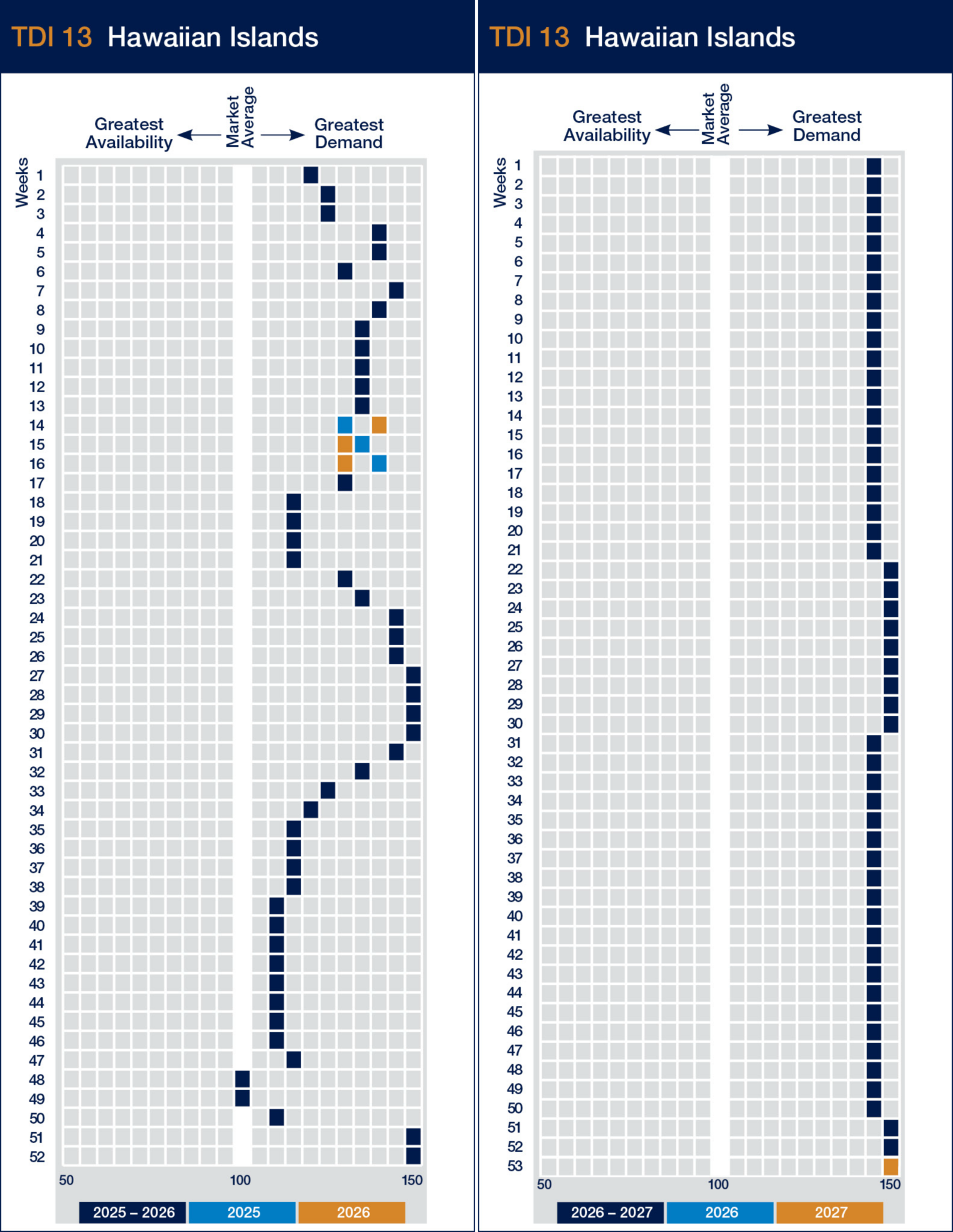
Separately, Interval revised a number of regional Travel Demand Index (TDI) charts in early 2026. Hawaii’s chart is a notable example, with every week of the year now rated either 145 or 150 on a scale that tops out at 150.
Since travel season and demand are stated factors in both Trading Power and Exchange Value, this revision is worth watching. However, Interval has not confirmed that TDI is directly integrated into the Uptrade calculation, so this connection remains an observation rather than a confirmed mechanic.
Who Benefits and Who Doesn’t Under Uptrade?
Based on what Interval has published so far, I don’t see this as a change with a single clear winner or loser. The impact will depend heavily on what you deposit and how you’ve historically used Interval.
Interval Members Who Benefits
Members with lower Trading Power stand to gain the most visibility. If Uptrade exposes exchange inventory that a lower-value deposit previously couldn’t access at all, paying a cash upgrade fee to unlock that inventory could represent genuine new value, even at $199 or $399.
Depends on Circumstances
Members with high Trading Power should continue trading well, but may face more competition. A strong deposit still allows access to desirable inventory within the two-point free allowance. Uptrade may expose that same high-value inventory to lower-Trading-Power members willing to pay cash. This could cause increased competition for the best weeks, which makes those with high-value deposits even more accessible.
Interval Members Who May Not Benefit
Some members may simply see new fees on exchanges they could previously make for free. If an exchange that carries no additional charge today ends up with an Exchange Value more than two points above a member’s Trading Power once Uptrade launches, that member could suddenly face a $99 to $599 fee for something that previously cost nothing extra.
The Takeaway
Here is the practical reality for weeks owners heading into October 2026: Trading Power is built largely from factors tied to the week itself, resort quality, unit size, season, and demand. The single most reliable way to maximize Trading Power over the long term is to own a high-quality week at a high-demand resort in the first place, rather than relying on recurring cash upgrade fees to bridge the gap between a modest deposit and the vacation you actually want.
As a timeshare resale broker with 25 years of experience, we consistently see high-demand, high-quality ownerships available on the resale market at a fraction of developer prices. Buying that kind of week to begin with, rather than depositing a lower-tier week and paying Uptrade fees indefinitely, remains the more cost-effective long-term strategy for anyone serious about maximizing their exchange power through Interval International.
If you’re evaluating your current ownership ahead of the October 2026 rollout, or considering a resale purchase specifically to strengthen your Trading Power, feel free to contact us, and our licensed agents would be glad to walk through your options.