

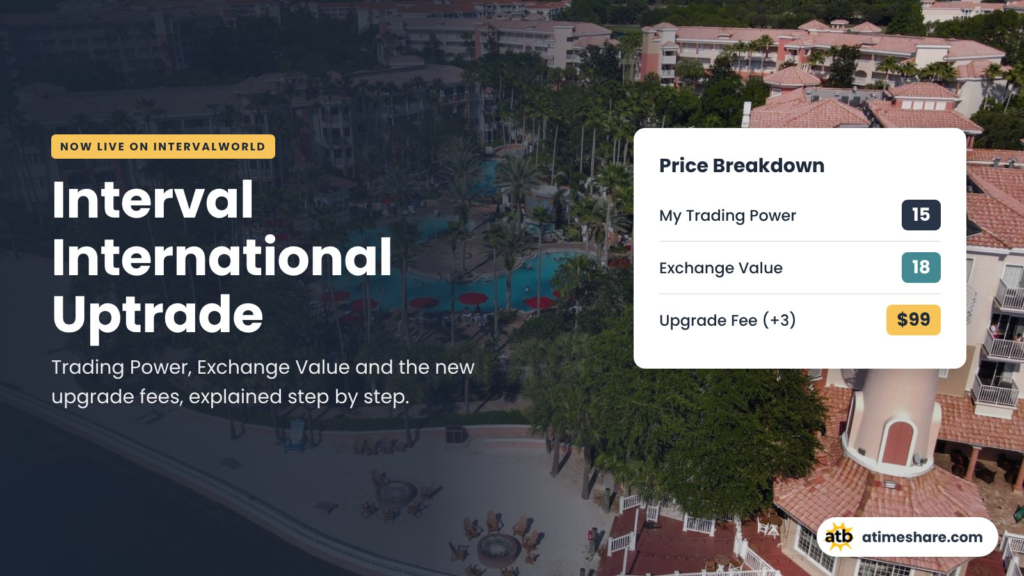
Interval International Uptrade changes the math behind every weeks exchange. Your deposited week now carries a visible number, the vacation you want carries one too, and the gap between them decides whether you pay an extra fee. Earlier, we explained what Uptrade was and when it would arrive.
Now that it is up and running on IntervalWorld.com, we tested it on a live member account with several deposited and undeposited weeks to show you exactly where each number lives and what it costs to trade up. In this article, we’ll explain everything that has changed with the new Uptrade program, and make you an instant power user. Let’s get started!
- Every deposited week gets a Trading Power. Every week in the search results shows an Exchange Value.
- You can book anything up to 2 points above your Trading Power at no extra charge.
- Beyond that, Interval International Uptrade adds an upgrade fee of $99, $199, $399 or $599.
- Interval International Uptrade also lets you check what an undeposited week is worth before you give it to Interval.
How Interval International Uptrade Works at a Glance
Two numbers do all the work under Interval International Uptrade, so it helps to know them before you click anything:
- Trading Power belongs to your week. Interval assigns it when you deposit, based on the resort’s Resort Recognition tier, the unit size, the travel season, demand and the date you deposited.
- Exchange Value belongs to the week you want. It appears under every available week in your exchange search.
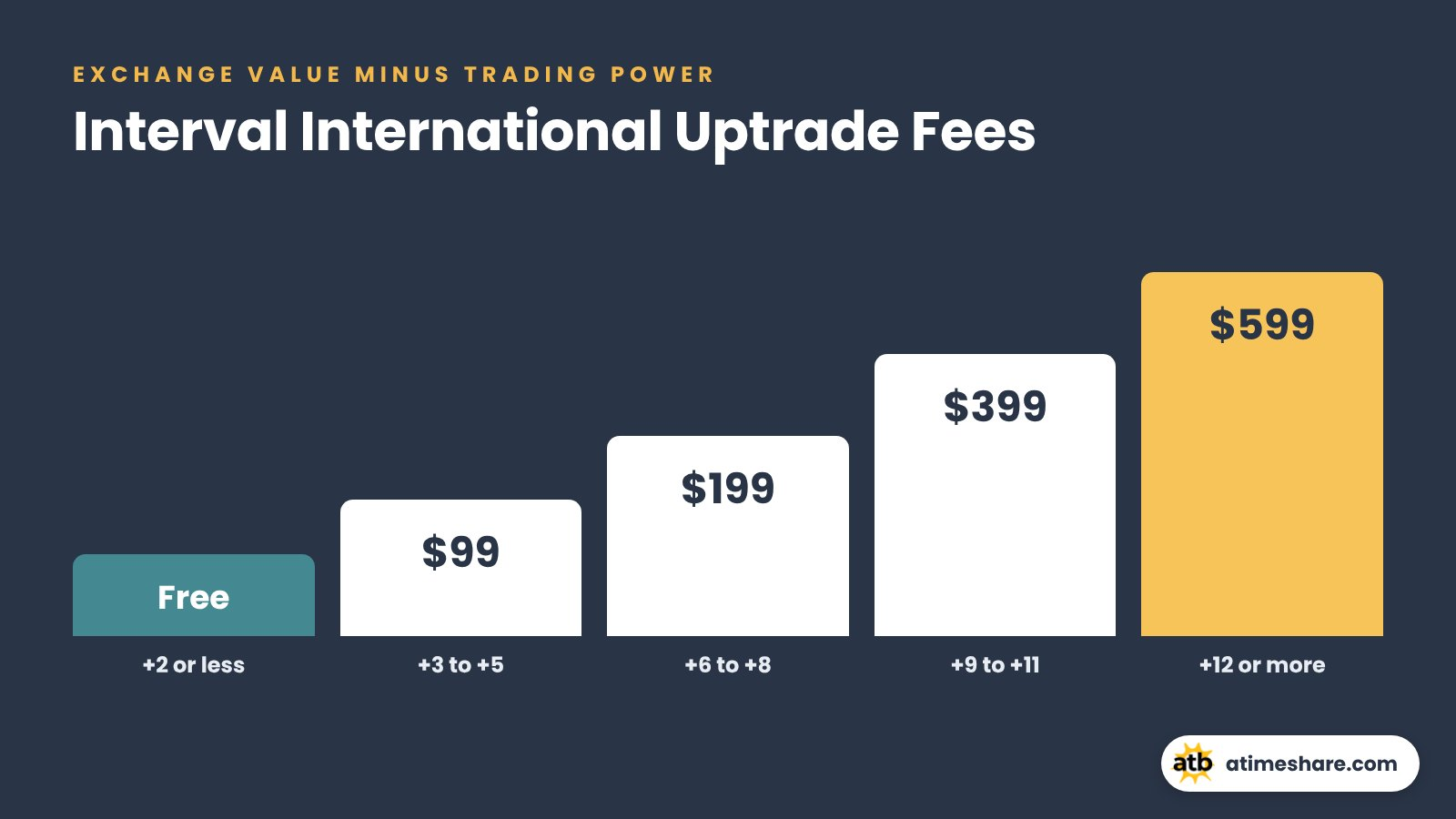
Subtract your Trading Power from the Exchange Value and you have what Interval International Uptrade calls the “difference.” That one figure sets your upgrade fee. According to the fee schedule in Interval’s Buyers’ Guide, there are five bands. The right-hand column shows what each band looks like for a deposit with a Trading Power of 15.
| Exchange Value Minus Trading Power | Upgrade Fee | Example: Trading Power of 15 |
|---|---|---|
| +2 or less | No additional fee | Exchange Values of 17 and below |
| +3 to +5 | $99 | Exchange Values of 18 to 20 |
| +6 to +8 | $199 | Exchange Values of 21 to 23 |
| +9 to +11 | $399 | Exchange Values of 24 to 26 |
| +12 or more | $599 | Exchange Values of 27 and above |
A quick Interval International Uptrade shortcut: add 2 to your Trading Power. The result is the highest Exchange Value you can book for free. From there, every three points moves you up one fee band. Keep in mind the upgrade fee is charged on top of the regular exchange fee, not in place of it.
Step 1: Price Out a Week Before You Deposit It
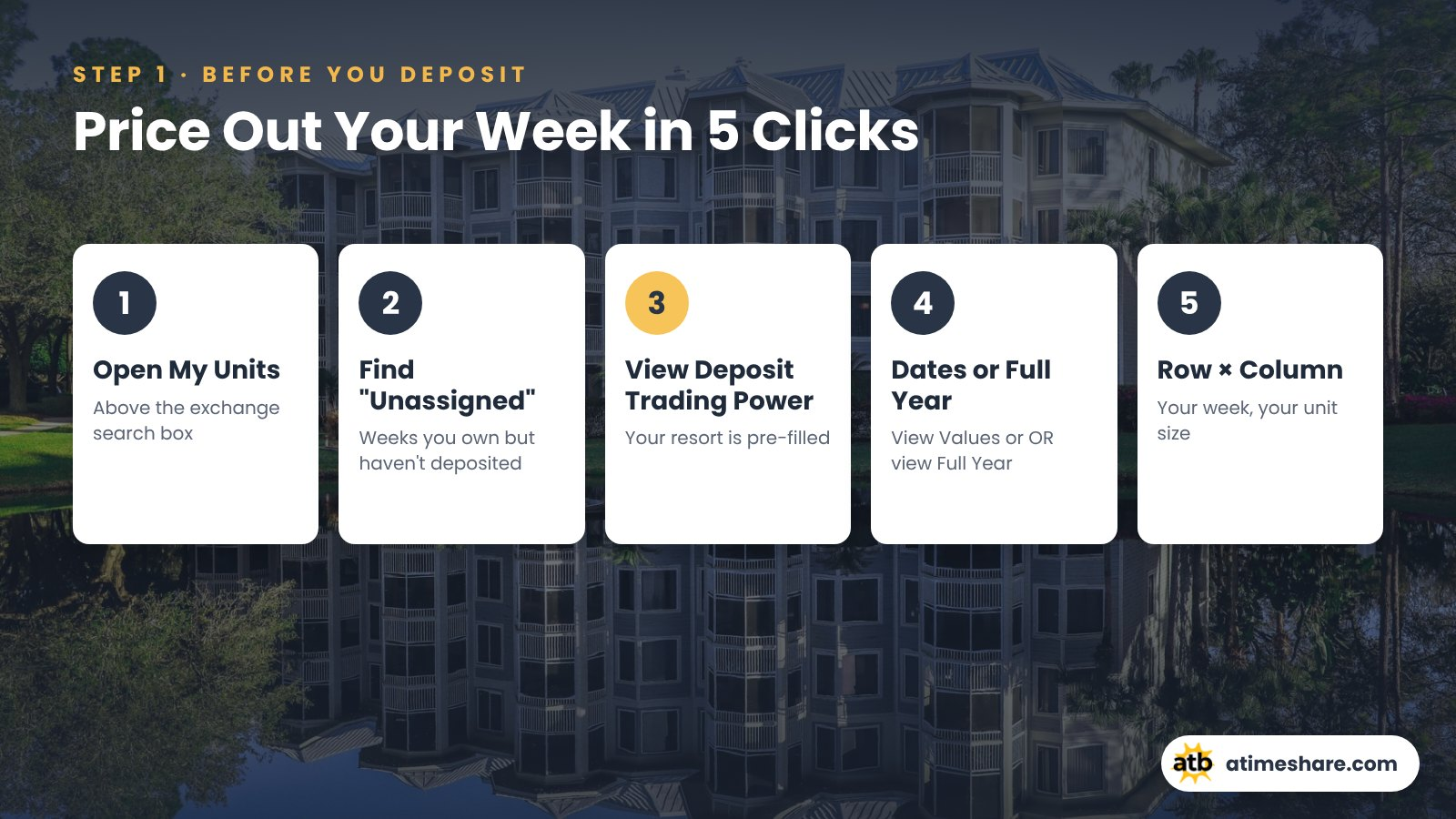
The most useful new feature of Interval International Uptrade is a calendar that tells you what a week would be worth before you deposit it. If you own a float week or have flexibility on dates, this is where you’ll want to spend your time.
Go to My Units
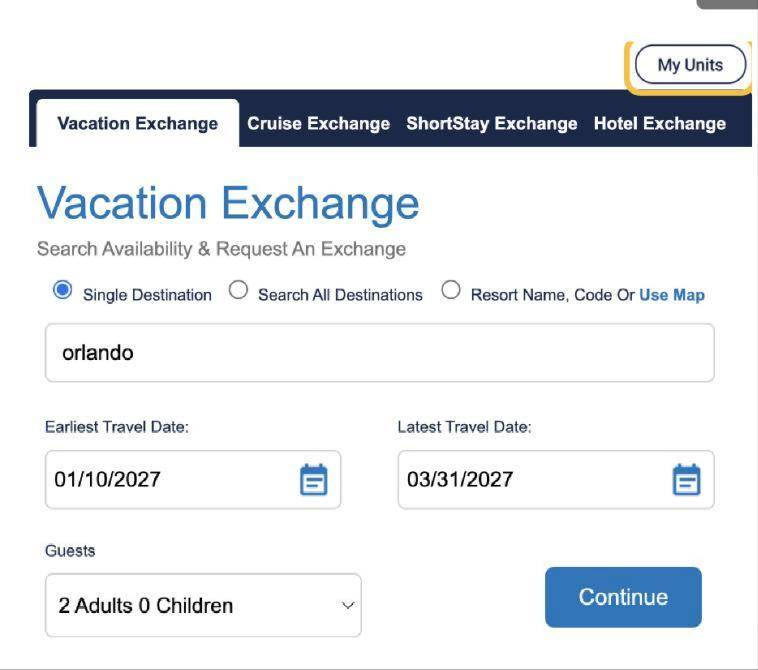
Open the Exchange tab and select the My Units button, which sits just above the vacation exchange search box.
Pick a week marked Unassigned
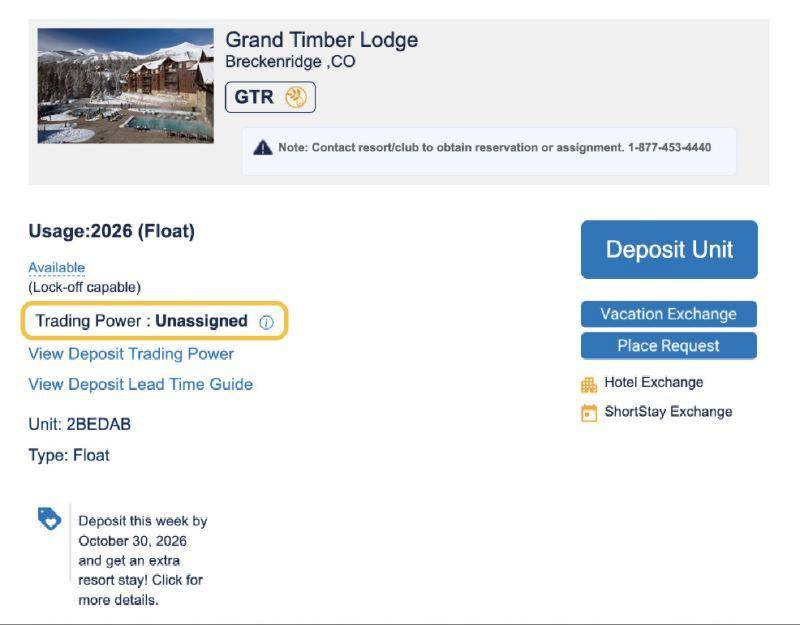
Any week you own but haven’t deposited shows “Trading Power: Unassigned.” In our example, that’s a float week at Grand Timber Lodge.
Open View Deposit Trading Power
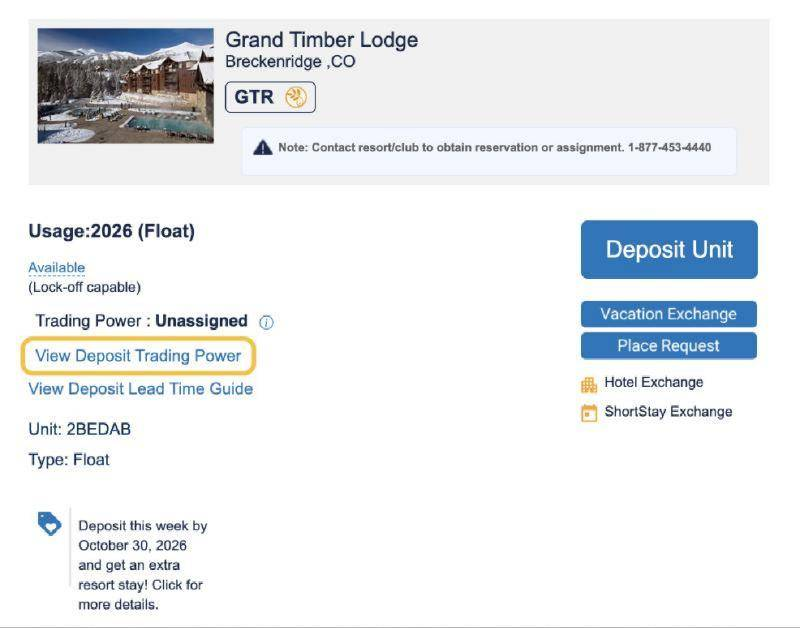
Click the View Deposit Trading Power link under that week. A pop-up opens with your resort already selected in the My Unit field.
Set a date range or load the whole year
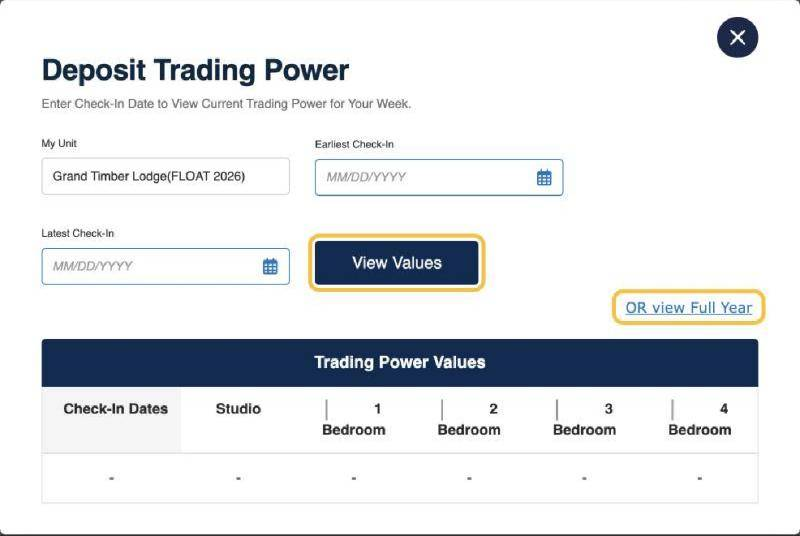
Enter your earliest and latest check-in dates and choose View Values. To see every week at once, choose “OR view Full Year” instead.
Match the row and column
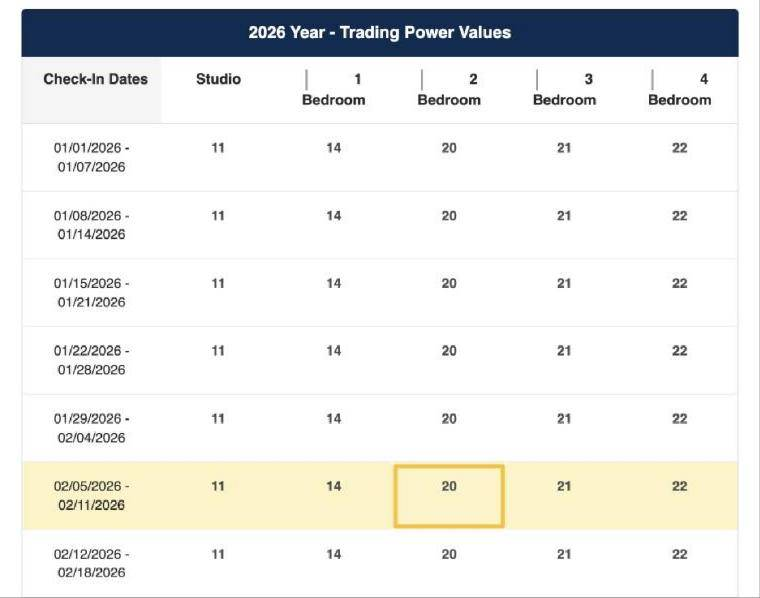
Go down to your check-in week and across to your unit size, from studio up to four-bedroom. That cell is the Trading Power the week would get if you deposited it now.
Nothing in this Interval International Uptrade calendar commits you. Browsing values never deposits a week. Only the button labeled Deposit Unit does that.
The Calendar Shows How Much Timing Matters
Two charts from the same account show how much the season moves the number. At Grand Timber Lodge in Breckenridge, Colorado, a two-bedroom is worth 20 during ski season. It drops to 14 in spring and fall and lands at 17 in summer. The Christmas and New Year’s weeks are the resort’s best, at 21 to 23 for a two-bedroom.
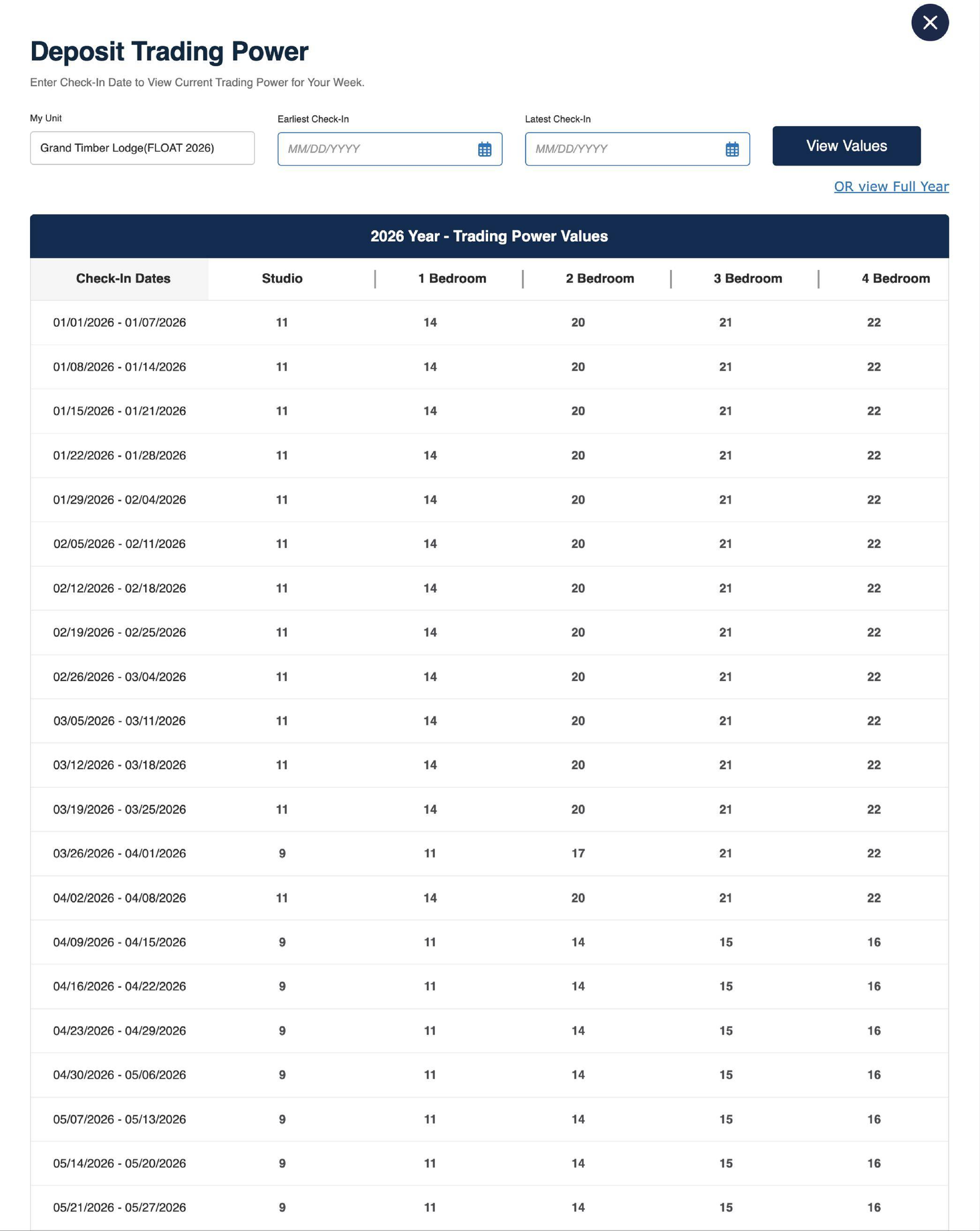
Marriott’s Harbour Lake in Orlando runs on a different calendar. Its two-bedroom sits at 14 in January, climbs to 20 from early February through the first week of April, and then settles back to 14 or 17 for much of the spring.
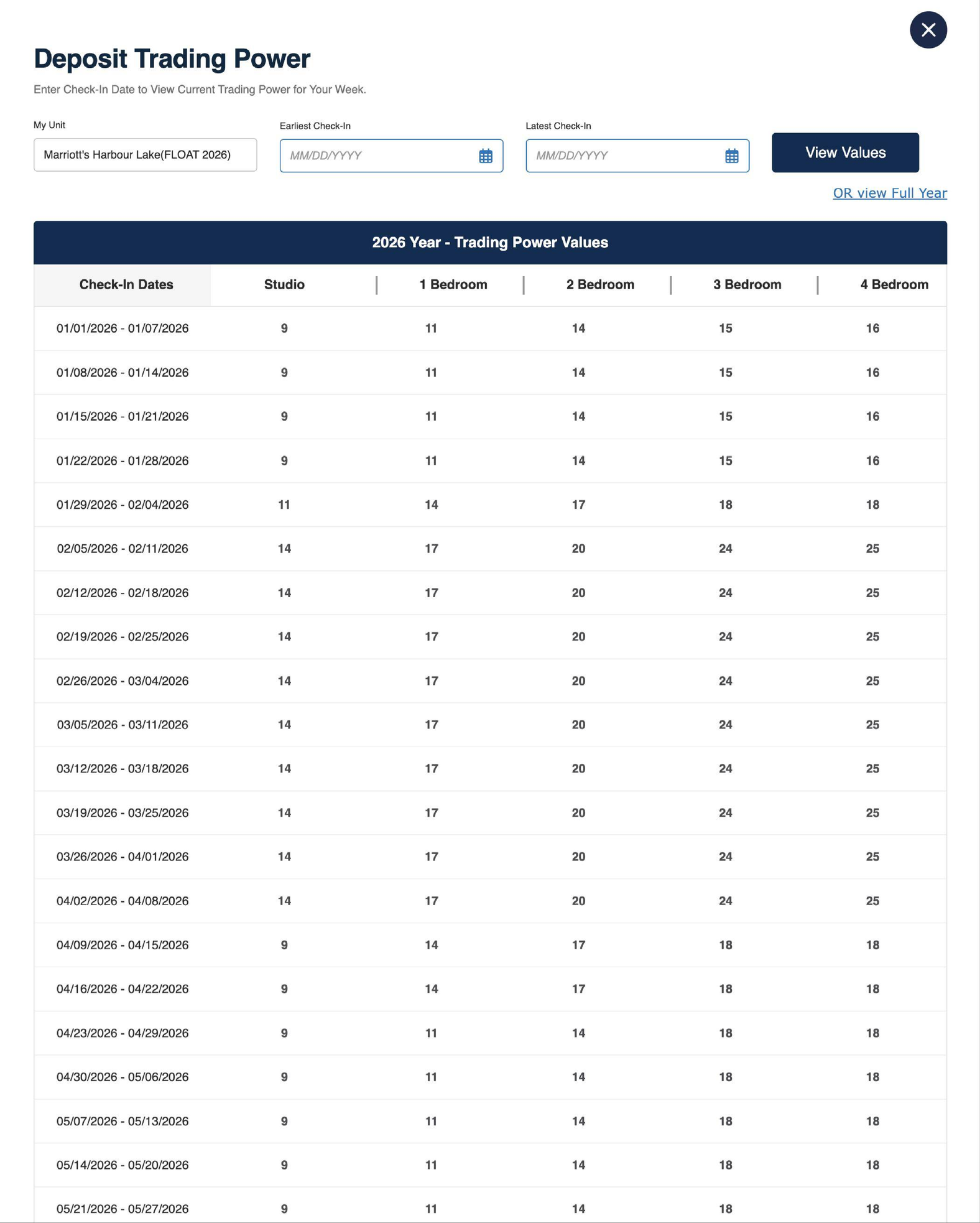
Both resorts can produce a 20 for a two-bedroom, just in opposite parts of the year. For float-week owners, that makes the week you reserve before depositing one of the biggest levers you have under Interval International Uptrade.
Deposit Date Is Part of the Formula
The calendar describes its numbers as the “current” Trading Power, and deposit date is one of the five factors Interval uses. While we were signed in, the account’s home page also kept prompting the member to deposit now to maximize Trading Power. Interval hasn’t said how much an early deposit adds. Still, the safe assumption is that the value you see today can change, so check the calendar again before you commit.
Lock-Off Owners: Compare the Whole Unit and the Halves
Lock-off units add another Interval International Uptrade decision. On the account we used, a 2027 two-bedroom lock-off at Westin Lagunamar in Cancun was valued at 27 as one unit. Split apart, the studio side was worth 16 and the one-bedroom side was worth 19. Together the halves add up to more than 27, but each one is weaker on its own. You’re choosing between two separate exchanges into smaller or less popular weeks and one exchange with more room to trade up before an upgrade fee applies.
Step 2: Find the Trading Power on Weeks Already Deposited
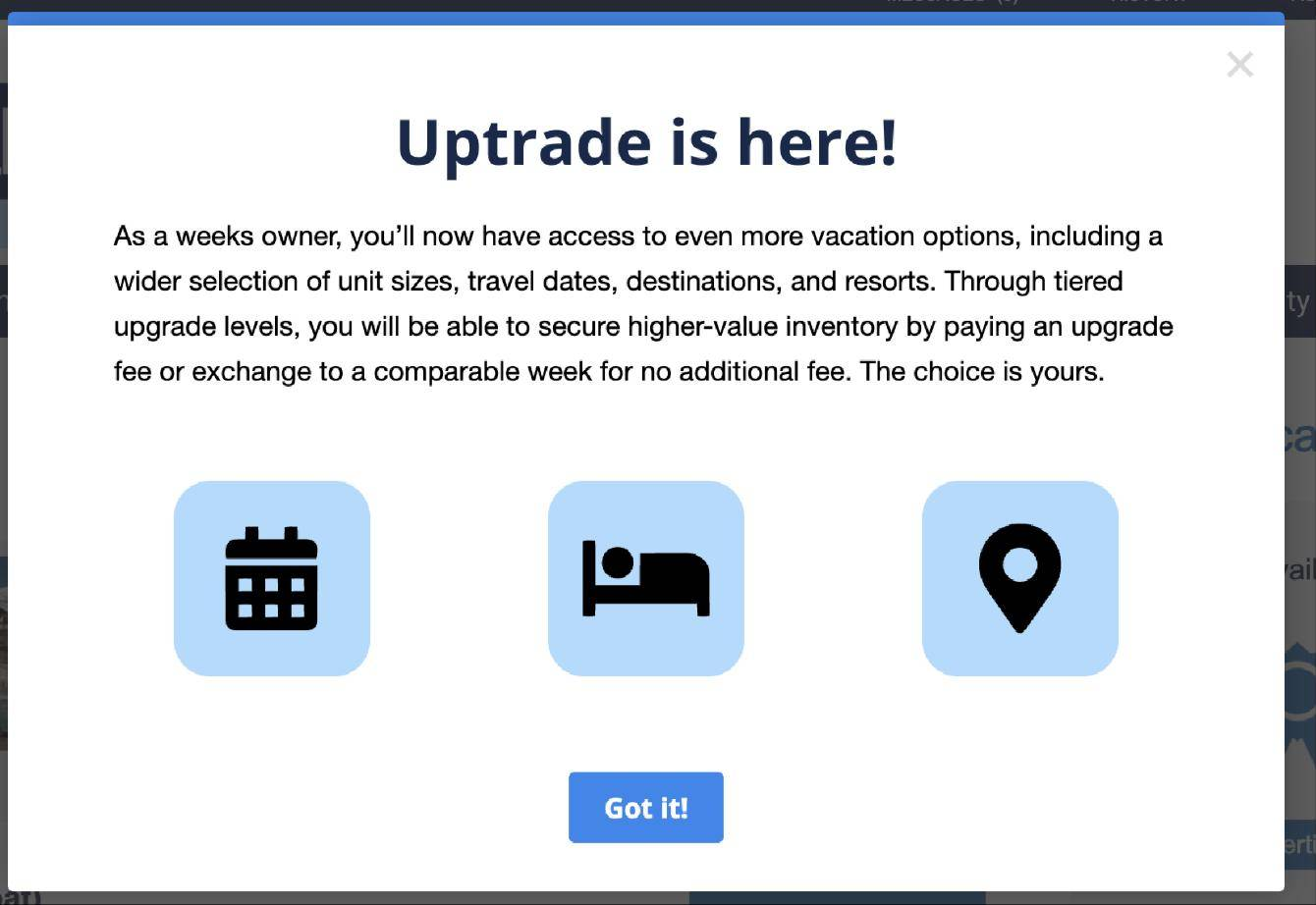
If you’ve already deposited, the number is waiting for you in a couple of places. Many weeks owners first meet Interval International Uptrade through a pop-up titled “Uptrade is here!” after signing in. It repeats Interval’s launch email: weeks owners can reach more unit sizes, dates, destinations and resorts, and can either pay to trade into higher-value inventory or exchange into a comparable week at no added cost.
After you close it, you won’t find a dedicated Interval International Uptrade page. The new numbers are built into screens you already know.
Interval International Uptrade on the My Units Page
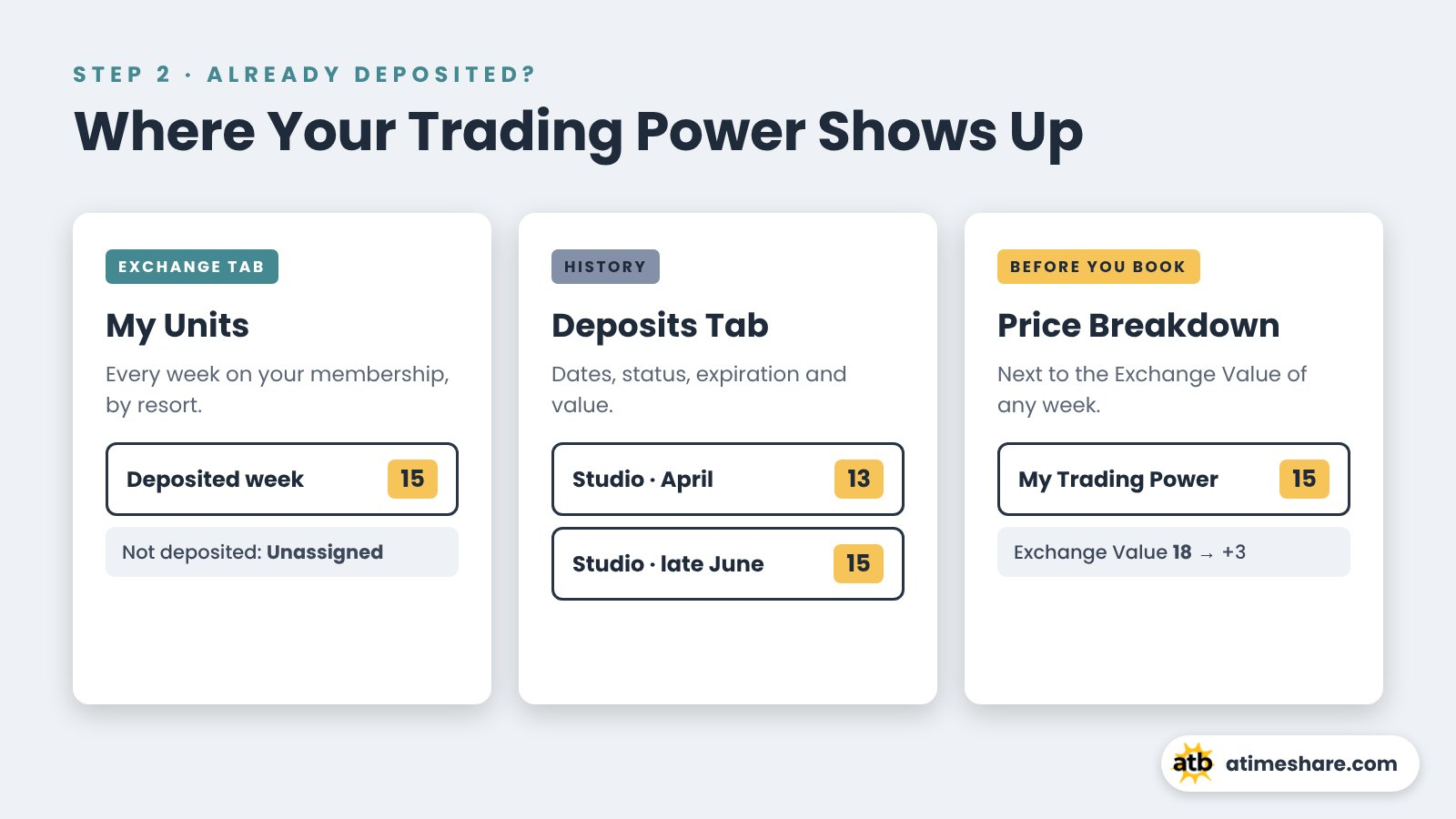
Under the Exchange tab, My Units lists every week on your membership, grouped by resort. A deposited week shows “My Trading Power” and a number. For example, a studio at Marriott’s Summit Watch deposited for week 26 shows a 15. A week you haven’t deposited reads “Trading Power: Unassigned,” with links to View Deposit Trading Power and View Deposit Lead Time Guide.
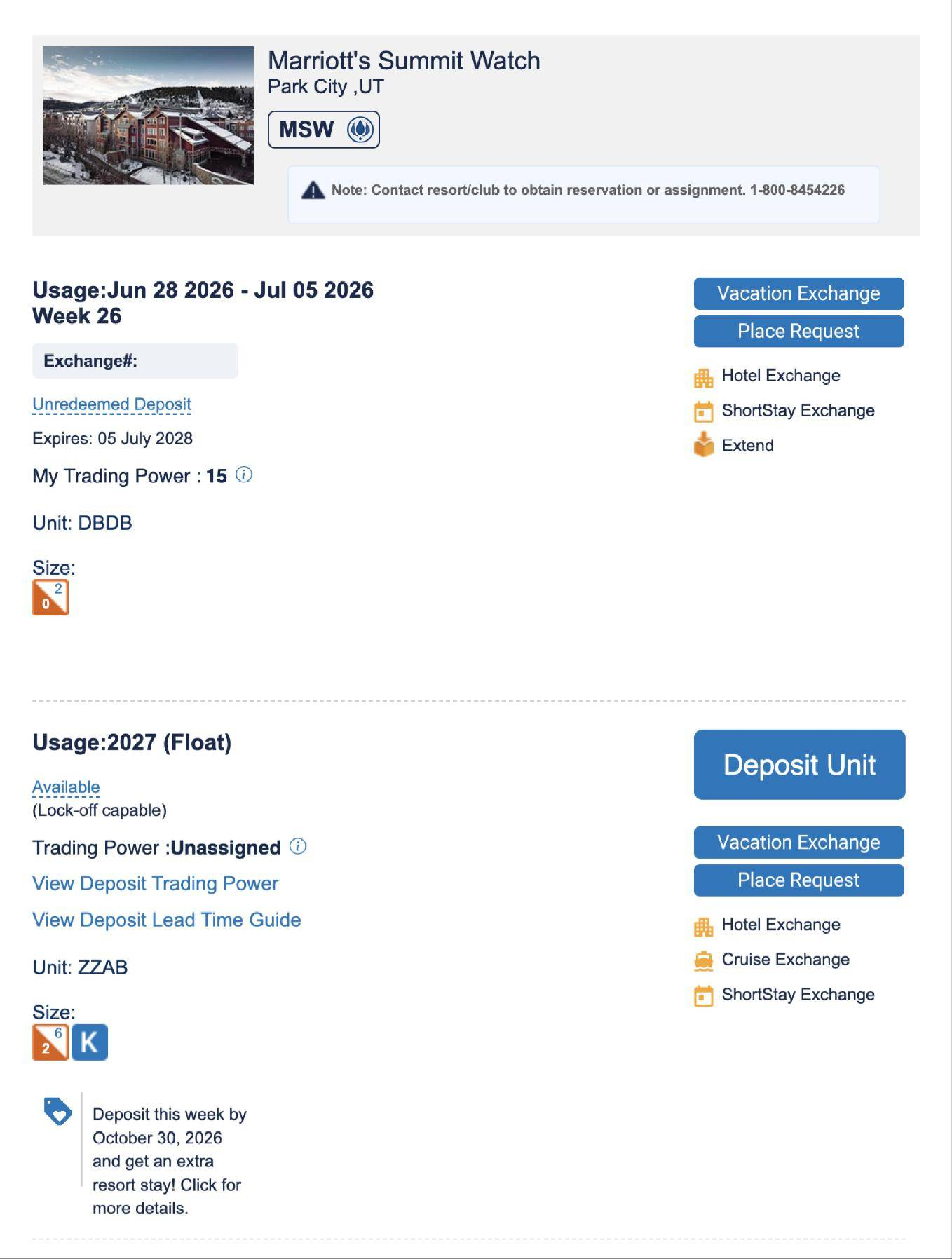
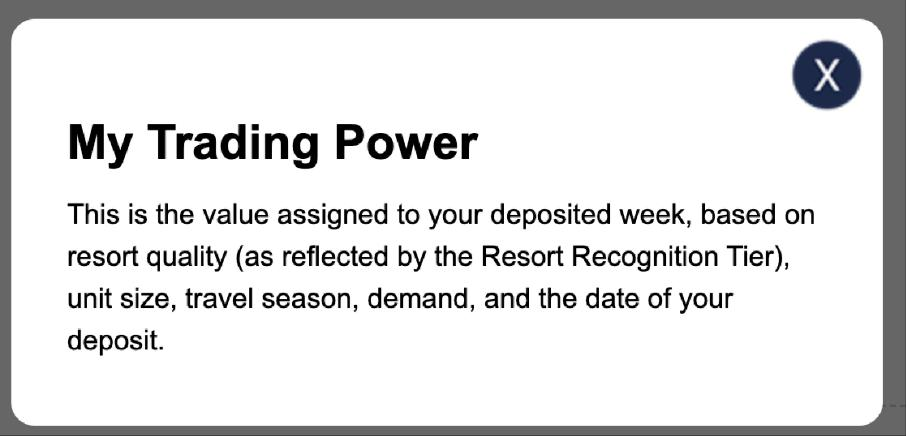
The small information icon next to the number opens Interval’s definition, which lists the same five factors: Resort Recognition tier, unit size, travel season, demand and deposit date.
In Your Deposit History
Select History in the top right corner of the site, then open the Deposits tab. Each deposit is listed with its check-in dates, status, expiration date and Trading Power, which makes this the best screen for comparing several deposits side by side.
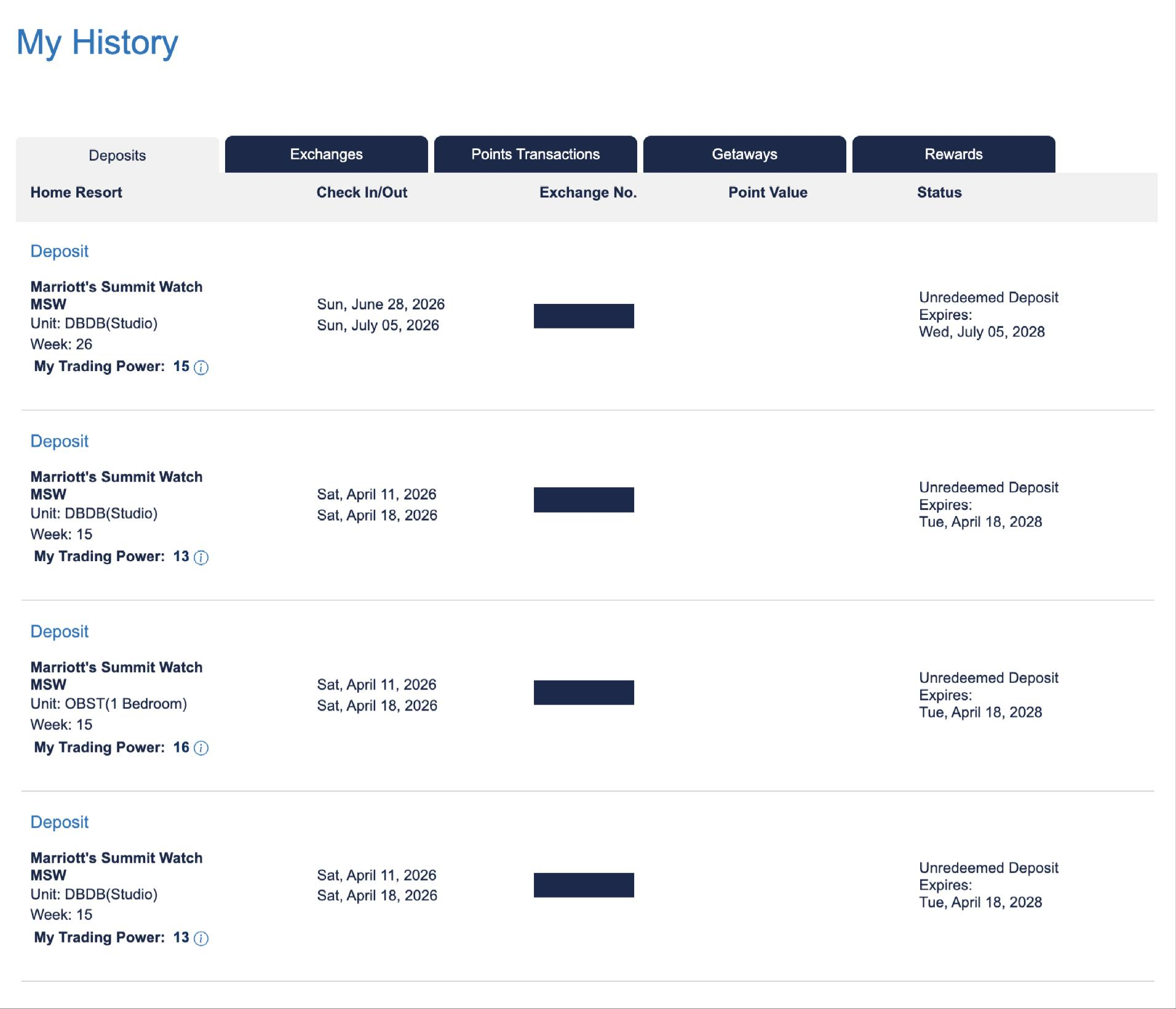
This screen shows two patterns worth knowing. The same Summit Watch studio was assigned 13 for an April week but 15 for a late-June week. And a two-bedroom lock-off deposited as two pieces for the same April week became a studio worth 13 and a one-bedroom worth 16. Each piece is a separate deposit with its own value, and each would be used for its own exchange.
Step 3: Compare Your Number to Exchange Value in an Interval International Uptrade Search
Exchange Value is the other half of Interval International Uptrade. Here’s how to see it next to your own Trading Power.
Run a vacation exchange search
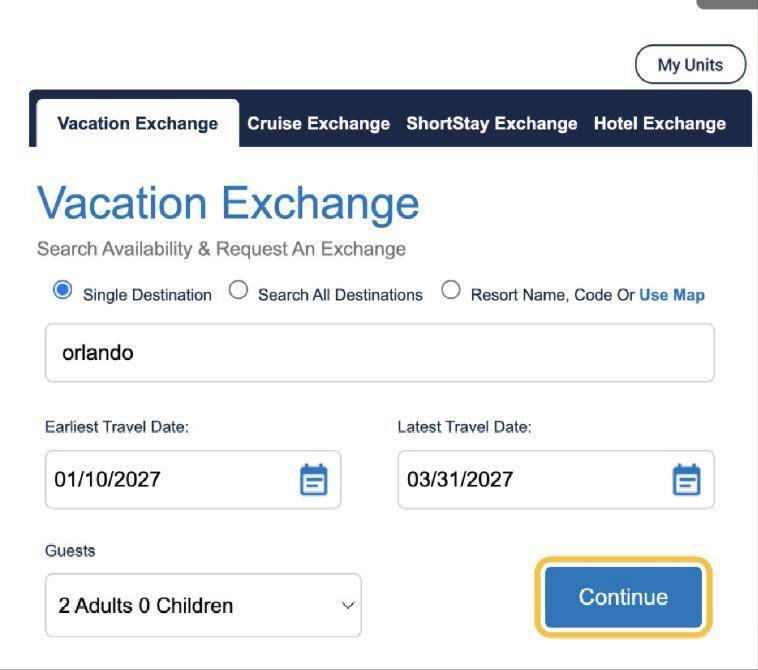
On the Exchange tab, enter a destination with your earliest and latest travel dates and choose Continue.
Use a deposited week
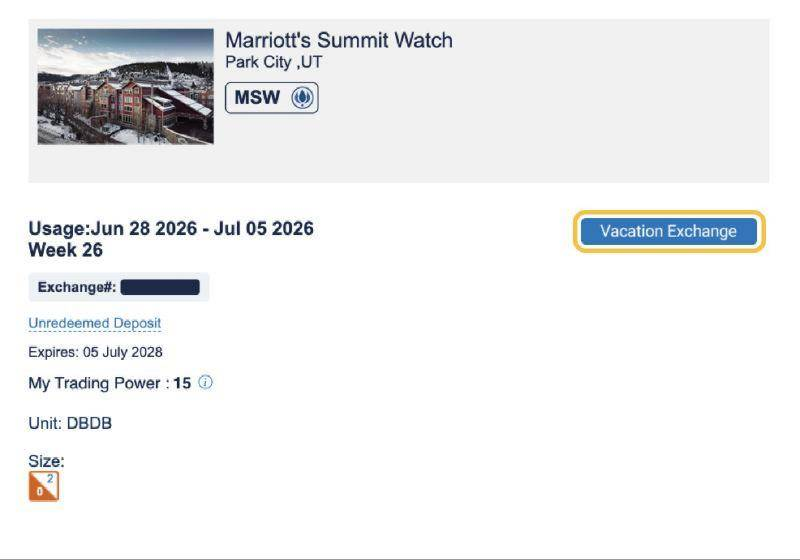
When Interval asks which unit to use, select a deposit that already has a Trading Power. Its value stays visible in the left column of the results for reference.
Check the Exchange Value on each week
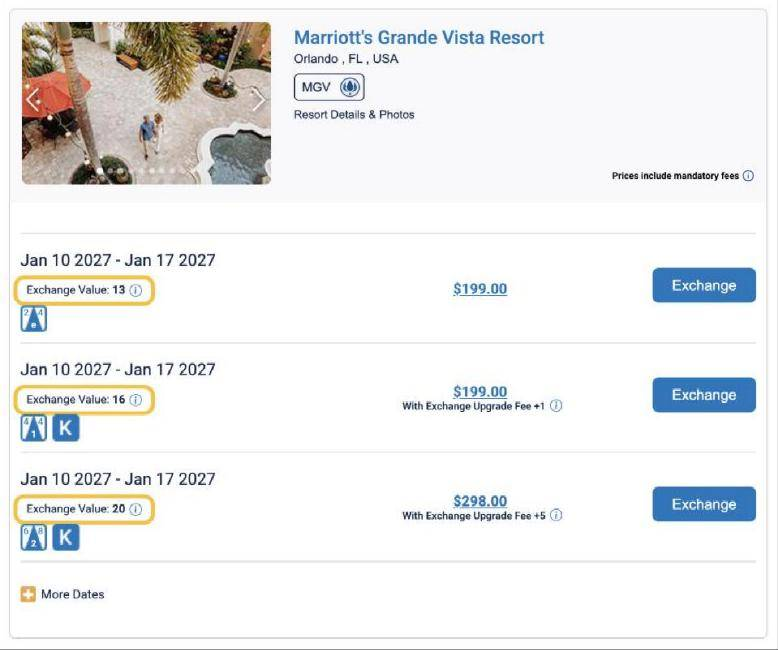
Each available week lists its Exchange Value below the travel dates, next to the unit-size icons.
Spot the upgrade label
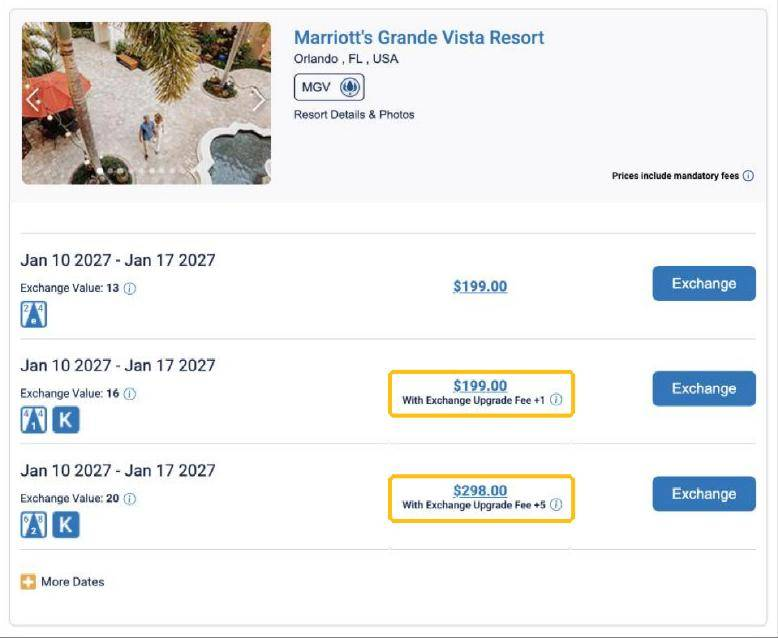
If a week’s Exchange Value is higher than your Trading Power, the price reads “With Exchange Upgrade Fee” followed by the difference, such as +3 or +5.
Open the Price Breakdown
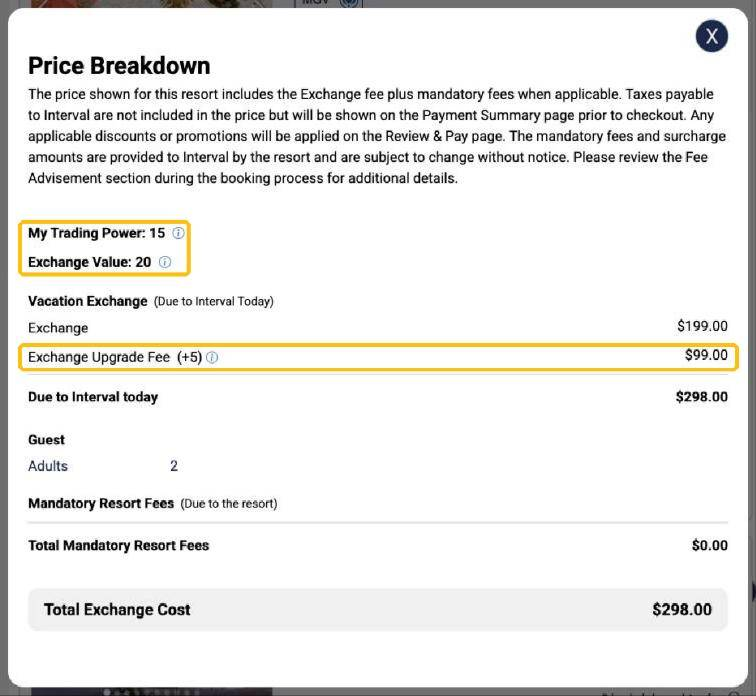
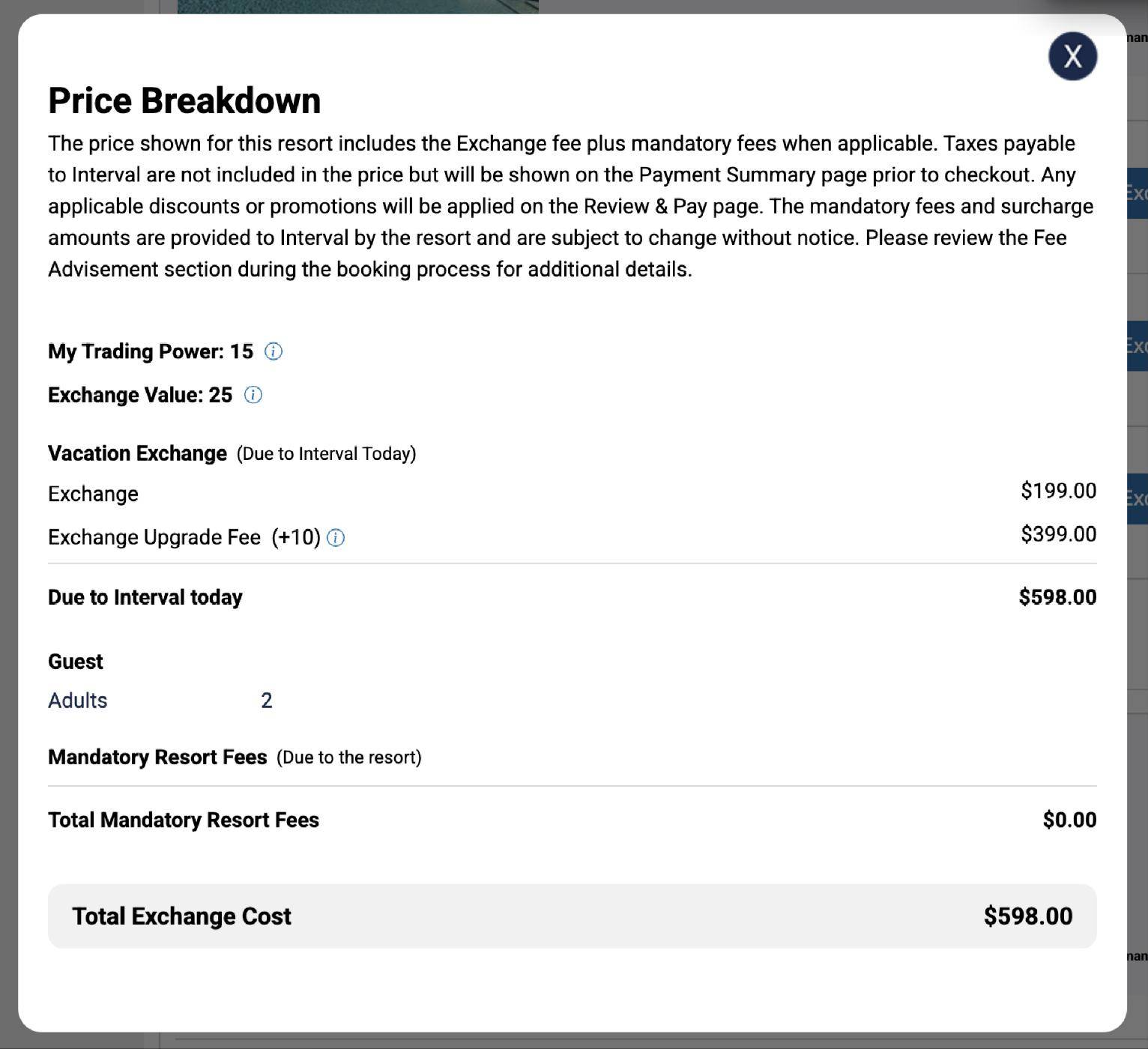
Click any price to see the Price Breakdown: your Trading Power, the Exchange Value, the exchange fee, any upgrade fee and any mandatory resort fees.
A Real Search: Orlando, January to March 2027
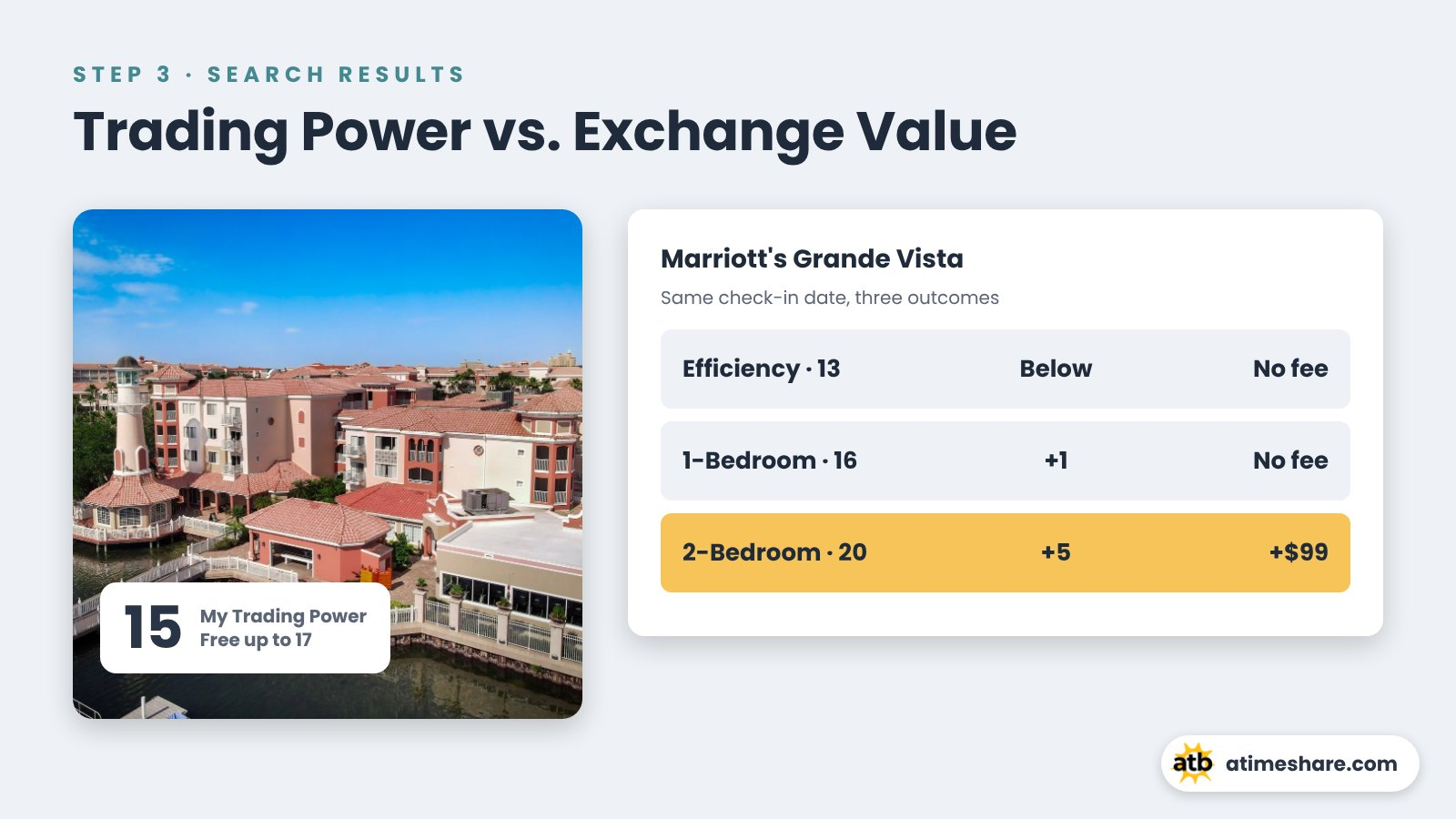
We searched Orlando for January through March 2027 using the Summit Watch studio with a Trading Power of 15. A single check-in date at Marriott’s Grande Vista turned up every possible outcome:
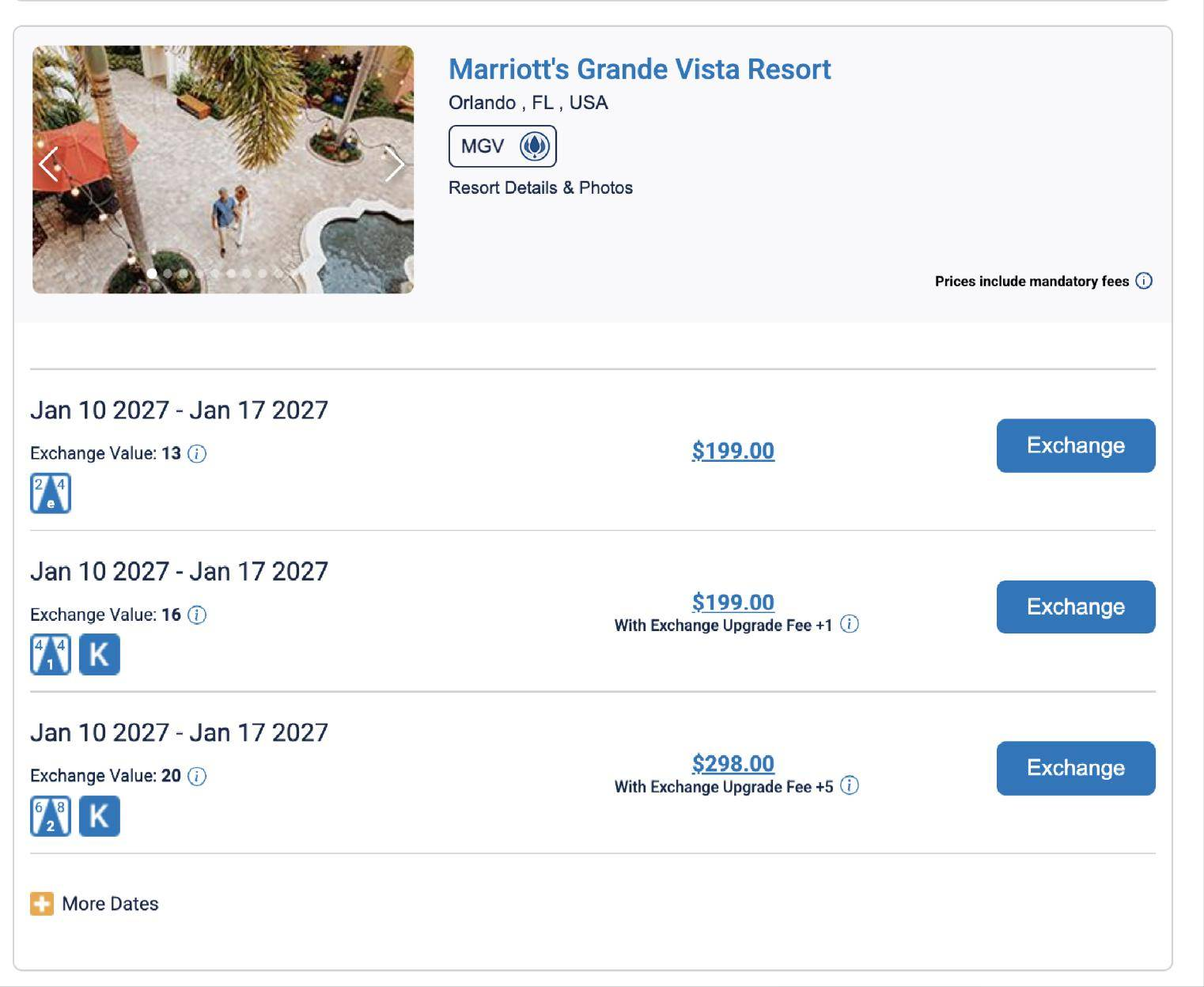
- Efficiency (Exchange Value 13): Below the deposit’s 15, so no upgrade fee.
- One-bedroom (Exchange Value 16): Tagged +1, but the price stays the same because it’s inside the two-point allowance.
- Two-bedroom (Exchange Value 20): At +5, the price goes up $99.
Don’t let the +1 tag worry you. It’s one of the more confusing parts of Interval International Uptrade. It only tells you how far a week sits above your Trading Power. It doesn’t mean you’ll be charged.
The table below collects more results from the same search, including resorts outside the Marriott brand.
| Resort, Unit and Month (Trading Power 15) | Exchange Value | Difference | Upgrade Fee |
|---|---|---|---|
| Marriott’s Harbour Lake, efficiency, January | 11 | -4 | None |
| Star Island Resort and Club, one-bedroom, January | 14 | -1 | None |
| Marriott’s Grande Vista, one-bedroom, January | 16 | +1 | None |
| Marriott’s Sabal Palms, two-bedroom, January | 18 | +3 | $99 |
| Marriott’s Cypress Harbour, two-bedroom, January | 20 | +5 | $99 |
| Sheraton Vistana Resort, two-bedroom, February | 25 | +10 | $399 |
Neighboring Resorts Can Price Differently
Under Interval International Uptrade, similar units in the same city and week don’t always share an Exchange Value. In mid-January 2027, two-bedrooms at Marriott’s Harbour Lake and Marriott’s Sabal Palms came in at 18, while two-bedrooms at Marriott’s Cypress Harbour and Marriott’s Grande Vista came in at 20. With a 15, both groups cost the same $99. With a 16, though, the first pair would be free and the second would still cost $99. One point of Trading Power can change which resort makes the most sense.
Demand shows up too. A two-bedroom at Sheraton Vistana Resort was valued at 18 in January but 25 in early February.
Step 4: Read the Price Breakdown Before You Pay
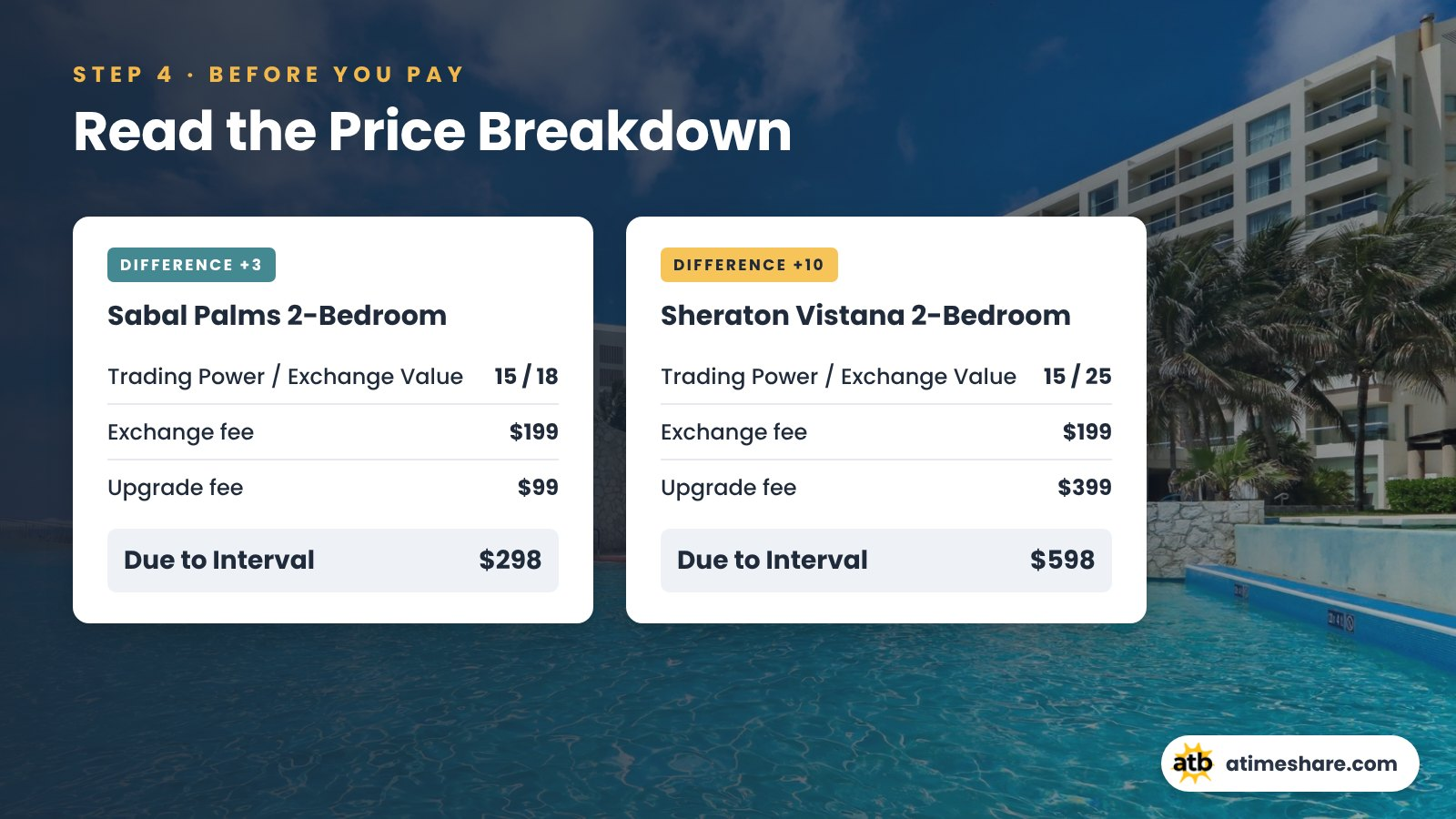
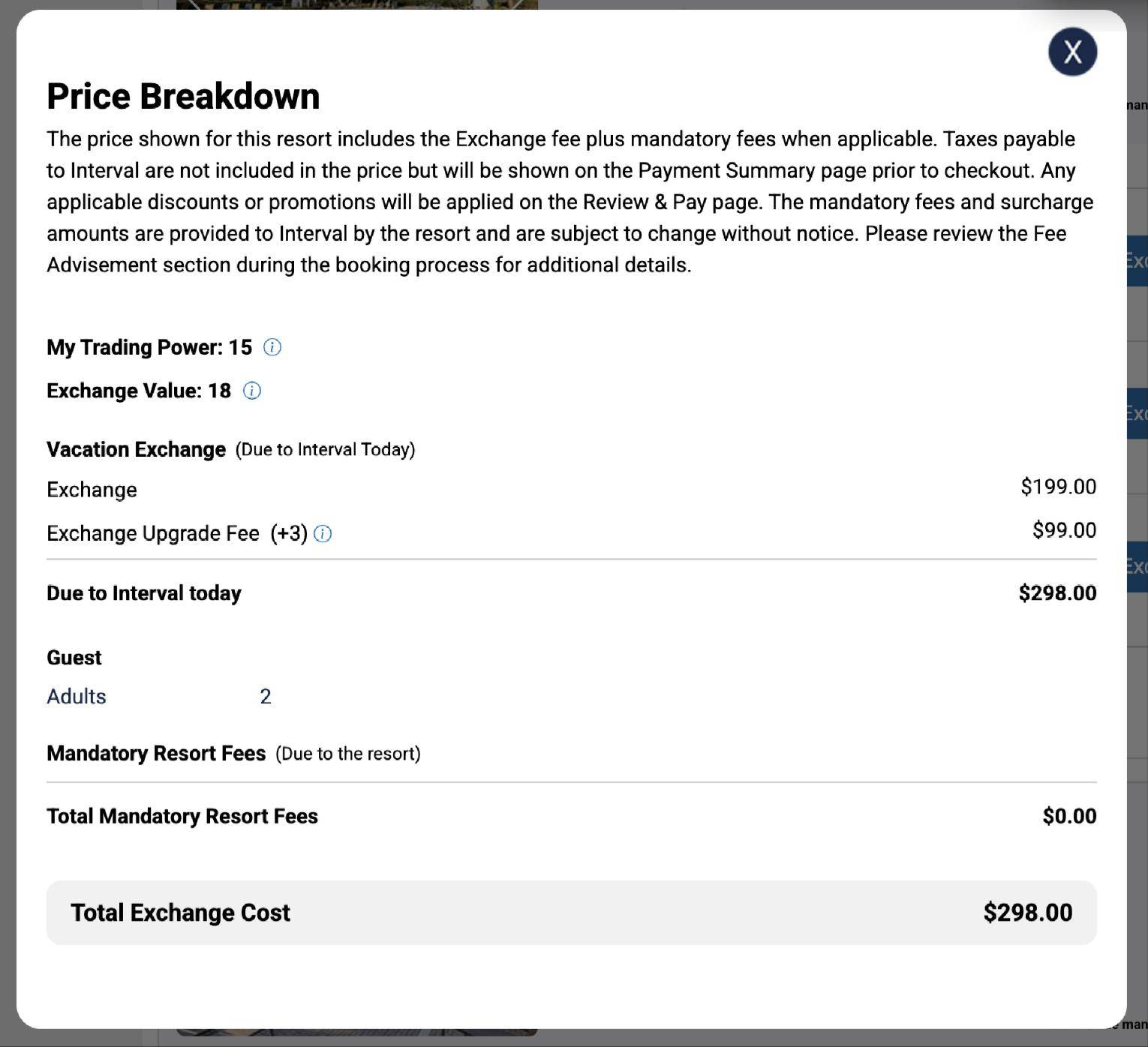
The Price Breakdown pop-up is where Interval International Uptrade fees turn into real dollars. Two examples from our Orlando search show how quickly the total can grow.
A $99 upgrade: The Marriott’s Sabal Palms two-bedroom has an Exchange Value of 18 against a Trading Power of 15, a difference of +3. The breakdown shows the exchange fee plus a separate $99 Exchange Upgrade Fee, for a total of $298 due to Interval.
A $399 upgrade: The February two-bedroom at Sheraton Vistana Resort has an Exchange Value of 25. Against the same deposit, that’s +10, which falls in the $399 band. The total due to Interval rises to $598.
Fine Print in the Pop-Up
- Taxes: The price in your search results includes the exchange fee and any mandatory resort fees, but not taxes owed to Interval. Those appear on the payment summary before checkout.
- Resort fees: Mandatory resort fees are broken out separately because the resort, not Interval, collects them. Several non-Marriott resorts in our Orlando search had these fees, which pushed their displayed prices well above the exchange fee.
- Promotions: Interval applies discounts and promotions on the Review and Pay page, so a deal you qualify for may not show up in the breakdown.
Why We Saw $199 Instead of $264
Interval’s fee schedule effective October 3, 2026, sets the full-week exchange fee at $264, and that’s what most non-Marriott resorts showed in our search. Marriott and Sheraton resorts, however, showed a base exchange fee of $199 in the Price Breakdown.
Our test account owns Marriott weeks being exchanged with other Marriott owned resorts, so this discounted rate is tied to that affiliation rather than a discount you can count on for every exchange that’s possible. Interval doesn’t explain the difference on screen, so don’t count on seeing $199 for all exchanges.
The Interval International Uptrade fees, on the other hand, matched the published schedule every time we checked. For the rest of Interval’s charges, see our complete guide to Interval International fees.
What We Haven’t Tested Yet
Interval International Uptrade still has a few corners we haven’t explored. Uptrade can be applied to a pending exchange request, but we haven’t yet seen how members choose the upgrade level they’re willing to pay when they place one. We also don’t know yet how E-Plus retrades handle an upgraded Exchange Value that carries forward. And we’re watching to see whether a deposit’s Trading Power can change after the deposit is made, or whether only the pre-deposit calendar moves.
We’ll share updates on the A Timeshare Broker blog as we test each one, so be sure to stay tuned to the blog for future updates!
Interval International Uptrade FAQ
Conclusion
For the first time, Interval International Uptrade lets weeks owners see the numbers behind an exchange. You can check what a week is worth before you deposit it, line that number up against the Exchange Value of the trip you want, and know your upgrade fee before you pay. Whether that works in your favor depends on the week you own, when you like to travel, and how often you traded up under the old system.
Before your next deposit or request, check the Deposit Trading Power calendar for your home resort and run a few searches on IntervalWorld.com. Your own numbers will tell you far more about Interval International Uptrade than any announcement can. If you’re weighing a membership upgrade too, compare the Interval membership tiers first.
Looking for a week with strong trading value, or ready to sell one you no longer use? Our team can help! Feel free to browse the active resale listings, or fill out a contact form for a free consultation with one of our licensed agents.