


Buying a timeshare on the resale market means weighing two very different ownership philosophies. Hilton Grand Vacations offers a single points-based system, while Marriott Vacation Club gives resale shoppers a choice between deeded Legacy Weeks and flexible Abound Club Points.
Read on to find the ultimate Marriott Vacation Club vs Hilton Grand Vacations showdown, and see how each brand stacks up across the factors that matter most to resale buyers.
Comparison Table: Marriott Vacation Club vs Hilton Grand Vacations
| Criteria | Hilton Grand Vacations ClubPoints | Marriott Abound Club Points | Marriott Legacy Deeded Weeks |
|---|---|---|---|
| Ownership structure | Points-based, deeded to a home resort, unit size, and season | Points-based, held through the MVC Trust land trust as Beneficial Interests, not tied to one resort | Deeded to a specific resort, unit type, and season (annual or odd/even year) |
| Resort network | HGV Club resorts across the U.S., Hawaii, Europe, Japan, Mexico, and the Caribbean | Over 90 Marriott, Westin, and Sheraton resorts worldwide | Limited to the deeded home resort unless traded through Interval International |
| Booking window | Home Week Priority up to 12 months before check-in at many resorts (varies by resort); Club Season around 9 months; Open Season 30 days | Up to 13 months before check-in depending on membership level | 12 months before check-in, or 13 months for concurrent or consecutive weeks |
| Retail-only perks lost on resale | HGV Max is not available to resale buyers | Developer-only Reserve and Pinnacle tiers; resale buyers can still reach Chairman’s Club. | Cannot convert to Bonvoy points or enroll in Abound if purchased after June 20, 2010 |
| Exchange company | RCI | Interval International | Interval International |
| Maintenance fees | Varies by home resort; 5.7 to 55.5 cents per ClubPoint (2026 data) | $0.8148 per point ($203.70 per Beneficial Interest of 250 points), plus annual club dues that scale by membership level | Billed per deeded week; varies by resort, so consult current resort-specific fee schedules |
| Points for a typical 2-bedroom week | 8,000 (Gold season) to 11,200 (Platinum season) ClubPoints at most resorts | About 2,000 to 2,500 points in a typical 2-bedroom scenario | Not applicable; the deed covers one week in the purchased unit type and season |
| Buying process | Licensed broker, select points and home resort, negotiate, Hilton right of first refusal, close through escrow | Licensed broker, select points package, negotiate, Marriott right of first refusal, close through escrow | Licensed broker, select resort and season, negotiate, Marriott right of first refusal, close through escrow |
What Is the Difference Between Hilton ClubPoints and Marriott’s Two Resale Products?
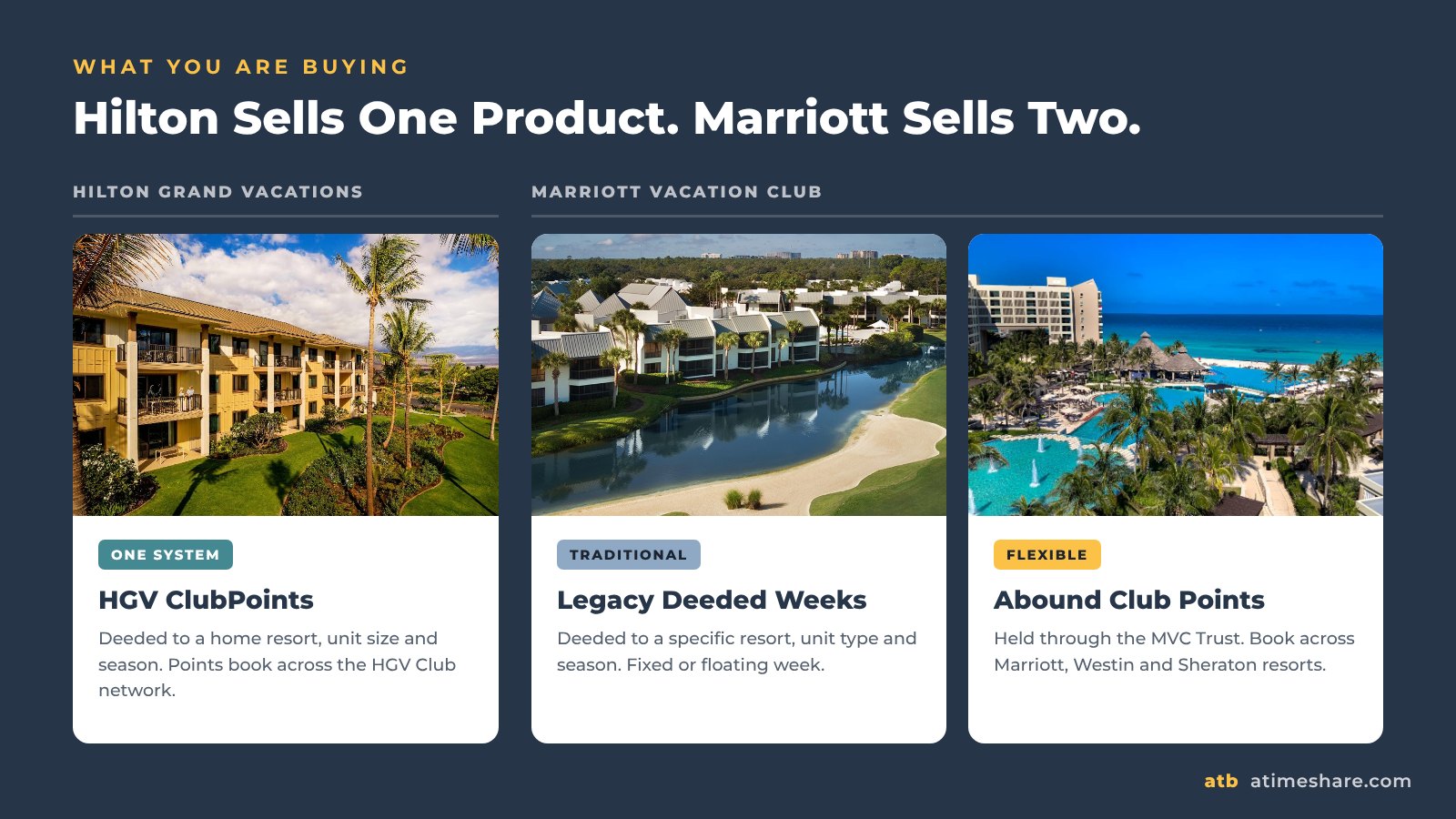
Hilton sells a single ownership type on the resale market: deeded weeks with ClubPoints used for their own internal exchange system. Marriott sells two distinct products, Legacy Deeded Weeks and Abound Club Points, and resale buyers need to understand both before deciding which brand, and which Marriott product, fits their travel style.
Hilton Grand Vacations ClubPoints: One Product, One System
HGV ClubPoints are deeded to a home resort, a specific unit size, and a season, with usage granted annually or on an odd or even year schedule. Owners receive an annual allotment of points tied to that deed, which they can use to book within the HGV Club network.
Hilton resale buying strategies:
- Buy at the resort with the lowest maintenance fees and book other locations during the Club Season window
- Buy directly at the resort they most want to visit to guarantee access during the Home Week Priority window.
The first approach keeps the purchase price and annual costs low while still giving you access to the full Hilton Grand Vacations resort portfolio. The second approach guarantees your home week but often comes with a higher purchase price and higher maintenance fees, particularly in Hawaii or New York.
You can learn more by visiting our guide that covers the two most popular strategies for buying a Hilton Grand Vacations ownership on the resale market.
Marriott Legacy Deeded Weeks: The Traditional Ownership Option
Legacy Weeks are the traditional Marriott Vacation Club ownership structure. Each contract is deeded to a specific resort, unit type, and season, whether that is a fixed week number or a floating week that can be reserved within a list of week numbers that are associated with the deeded season.
Resale buyers book exactly as the original owner did, up to 12 months before check-in, or 13 months when booking concurrent or consecutive weeks.
Many resale buyers also choose a Legacy Week for its trading power. Learn more about buying a legacy week in order to exchange it using Interval International. One important resale restriction applies: Legacy Week contracts purchased after June 20, 2010 cannot be converted to Marriott Bonvoy points, and cannot be enrolled in the Abound Club points program later.
Marriott Abound Club Points: Flexibility Across Three Brands
Abound Club Points, formerly known as Destinations Club Points, are held through the MVC Trust rather than deeded to a single resort. This structure gives owners the flexibility to book across Marriott Vacation Club, Westin Vacation Club, and Sheraton Vacation Club resorts, a network that spans over 90 properties.
Membership levels determine how far in advance an owner can book and how many consecutive nights they can reserve, with higher point totals unlocking earlier booking windows of up to 13 months.
Resale Abound Club Points buyers keep nearly all the same rights and benefits as retail buyers. The one exception, Marriott’s developer-only Reserve and Pinnacle tiers, is covered below.

How Do the Resort Networks Compare?
Marriott’s Abound network is larger on paper, spanning more than 90 resorts across three brands. The HGV resort count includes properties in the continental United States, Hawaii, Europe, Japan, Mexico, and the Caribbean.
















How Flexible Is Booking With Each Ownership Type?
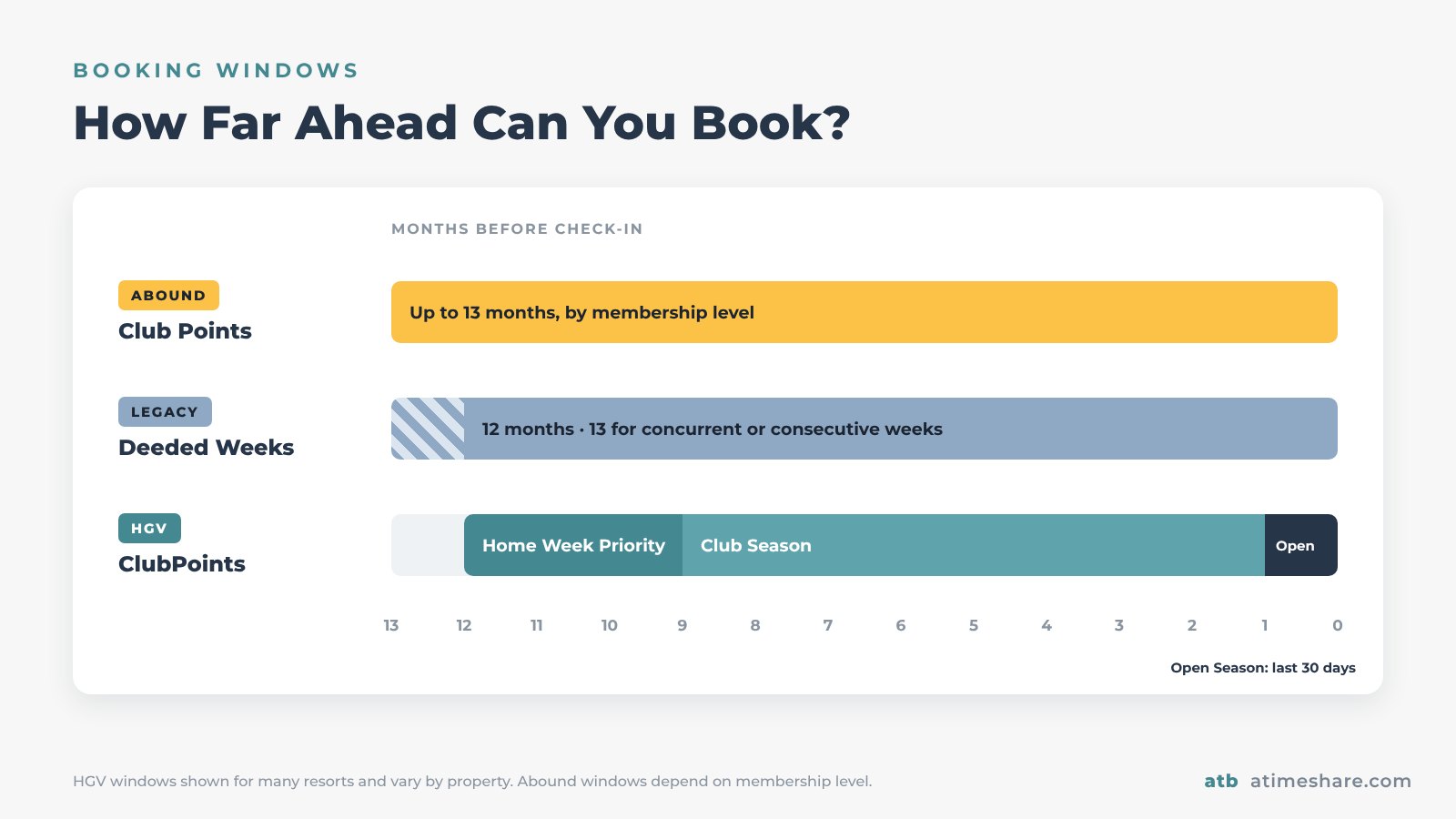
Marriott Legacy Weeks and Abound Points both open 12 to 13 months before check-in, while HGV’s Home Week Priority window opens up to 12 months before check-in at many resorts, though this varies by property.
How Hilton Grand Vacations Booking Windows Work
Hilton’s booking system layers several windows on top of each other:
- Home Week Priority lets owners book their exact deeded unit, season, and resort using only current use-year ClubPoints, with no borrowed, rescued, or deposited points allowed.
- The Club Season window, typically opening around 276 days (about 9 months) before check-out, opens any resort, unit type, and season in the HGV network, subject to availability, with a 3-night minimum.
- A narrower Hilton Club Priority window, 104 to 90 days before check-out, applies only to owners of Hilton Club properties.
- Open Season allows discounted cash bookings from 30 days before check-out through the day before check-in, though the owner must be the one to check in and no guest reservations are permitted.
For a full breakdown of these windows by resort, see our HGV booking windows guide.
How Marriott Vacation Club Booking Windows Work
Marriott Legacy Week owners can book 12 months before check-in, extending to 13 months for concurrent or consecutive week reservations. Abound Club Points owners can book up to 13 months in advance, with the exact window depending on their membership level.
For a full breakdown of these windows by product, see our Marriott Abound Points and Legacy Weeks booking windows guide.
What Retail-Only Benefits Do Resale Buyers Lose?
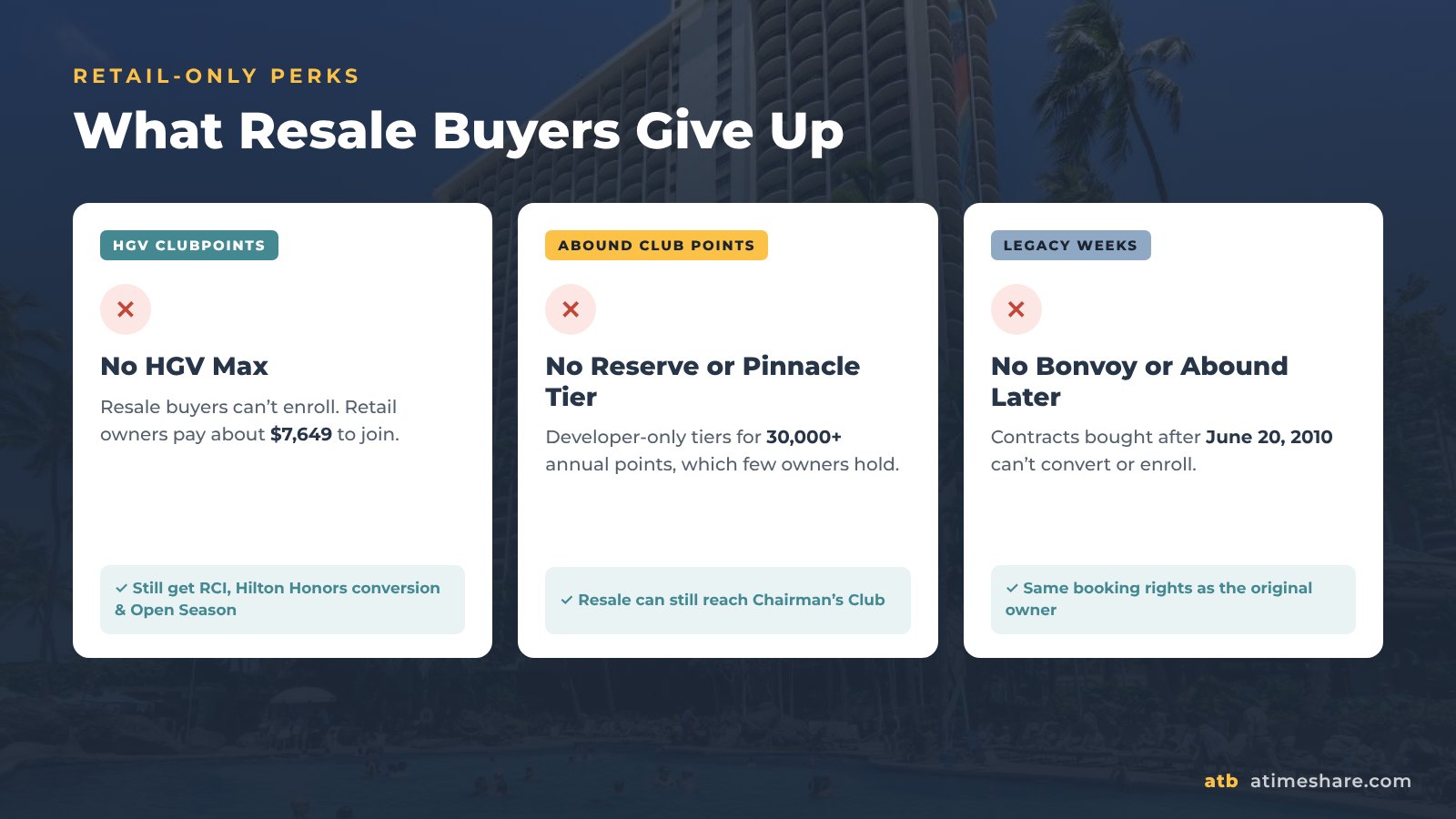
Hilton resale buyers lose eligibility for HGV Max, while Marriott Abound resale buyers retain most of the same rights as retail buyers.
Abound Club’s Newest Membership Levels: Resale Restrictions
Marriott’s two highest-tier membership levels, Reserve (30,000 to 49,999 points) and Pinnacle (50,000 points and above), require annual point totals far beyond what most owners hold and are exclusive to Club Points and Enrolled Weeks purchased directly from or through the developer. Resale buyers can still reach Chairman’s Club and all levels below it.
Marriott Legacy Weeks Resale Restrictions
Legacy Week resale buyers face one restriction: contracts purchased after June 20, 2010 cannot be converted to Bonvoy points or later enrolled in the Abound program.
Hilton Grand Vacations Resale Restrictions
HGV Max is Hilton’s enhanced membership tier, automatically included with new retail ClubPoint purchases. Existing retail owners can join by paying an activation fee of $199, an ownership change fee of $450, and an initiation fee of $7,000, for a total of approximately $7,649. Resale buyers are not eligible to enroll in HGV Max under any circumstance.
That said, resale HGV owners still retain several core benefits: booking at HGV and Hilton Club resorts within the standard windows, RCI exchange access, Hilton Honors point conversion, and the ability to make discounted cash bookings through Open Season.
Unless a buyer plans to purchase a very large number of points at retail, HGV Max benefits generally are not worth their cost, especially since Diamond Resorts properties (now Hilton Vacation Club) are RCI-affiliated and accessible through a standard RCI exchange.
How Do Maintenance Fees Compare?
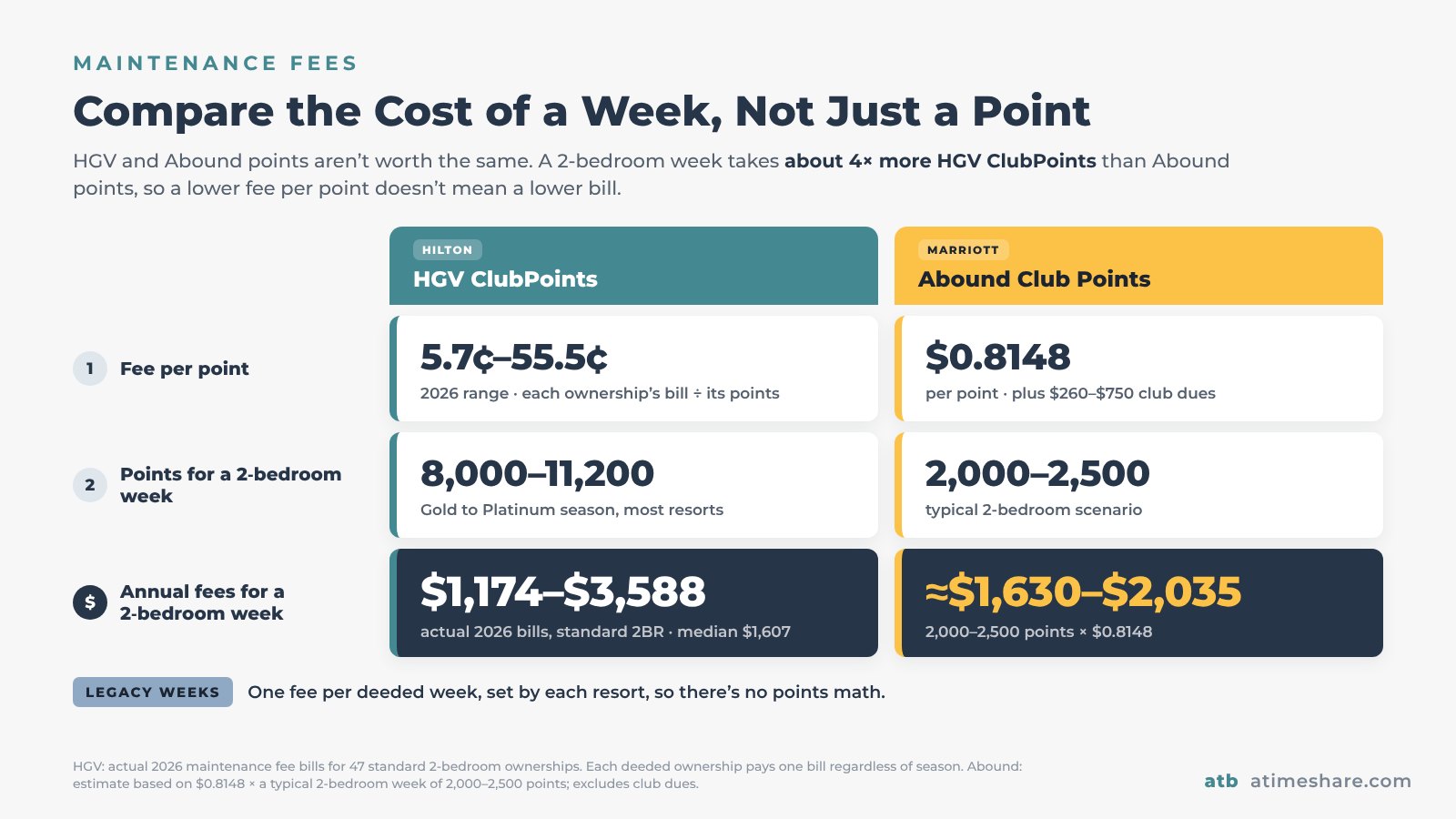
Hilton maintenance fees vary by home resort from 5.7 to 55.5 cents per ClubPoint (2026 data), while Marriott Abound fees are $0.8148 per point. At first glance, Hilton looks far cheaper, but the per-point figures can’t be compared directly.
The two points systems work differently, and a reservation of the same size costs a very different number of points in each. Hilton also bills each deeded ownership a single annual fee, so the cost per point is simply that bill divided by the ownership’s points, not a rate you can apply to any number of points.
Compare the Cost of a Week, Not Just a Point
A standard 2-bedroom week at most HGV resorts requires 8,000 ClubPoints in Gold season and 11,200 ClubPoints in Platinum season, and premium properties in Hawaii and other high travel demand locations often require more. With Abound Club Points, a typical 2-bedroom week requires about 2,000 to 2,500 points, though the exact cost depends on the resort, season, and view. In other words, a 2-bedroom week takes about four times as many HGV ClubPoints as Abound points.
| 2026 figures | HGV ClubPoints | Marriott Abound Club Points |
|---|---|---|
| Maintenance fee per point | 5.7 to 55.5 cents (each ownership’s bill divided by its points) | $0.8148, plus annual club dues |
| Points needed for a 2-bedroom week | 8,000 (Gold) to 11,200 (Platinum) at most resorts | About 2,000 to 2,500 in a typical scenario |
| Annual maintenance fees for a 2-bedroom week | $1,174 to $3,588 in actual 2026 bills for standard 2-bedroom ownerships (median about $1,607) | About $1,630 to $2,035 (2,000 to 2,500 points at $0.8148), before club dues |
Hilton Grand Vacations Maintenance Fees
Each deeded HGV ownership pays one annual maintenance fee bill, set by its home resort and unit type, regardless of season. In 2026, standard 2-bedroom ownerships pay between $1,174 and $3,588. Because a Platinum ownership receives more points than a Gold ownership of the same unit for the same bill, peak-season ownerships usually have the lowest cost per point. See our 2026 HGV maintenance fee page for every resort’s figures.
Marriott Abound Maintenance Fees
Marriott’s Abound maintenance structure is centralized through the MVC Trust. The 2026 fee is $0.8148 per point. Annual club dues scale by membership level, ranging from $255 for Owner and Select tiers in 2026 up to $320 for the Chairman’s Club tier.
Check out the 2026 Annual Fees For Abound Members page for all the figures for each membership level.
Marriott Legacy Weeks Maintenance Fees
Legacy Deeded Week maintenance fees vary by resort; see the 2026 Marriott deeded week maintenance fee page for resort-specific figures.
How Much Can Resale Buyers Save Compared to Retail?
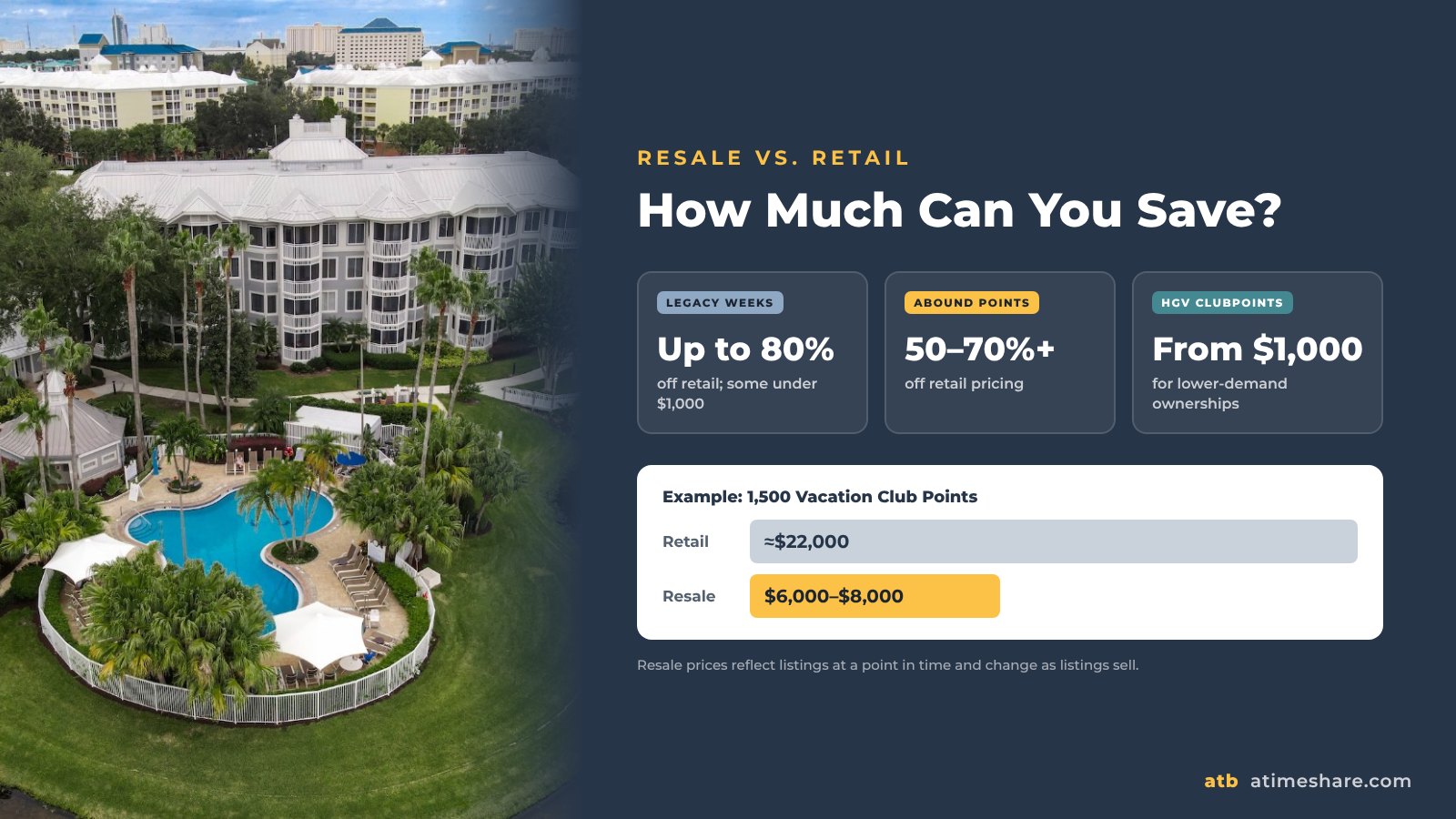
Marriott Legacy Weeks offer the deepest resale discounts, with savings reaching as high as 80 percent. Abound Club Points typically sell for 50 to 70 percent or more below retail, and Hilton discounts vary by resort, unit size, and season.
Marriott Legacy Weeks: Deepest Discounts on the Resale Market
Legacy Weeks are the most straightforward value play on the resale market with savings of up to 80 percent compared to buying directly from Marriott, with some deeded weeks listed under $1,000. Some highly desirable deeded weeks for event weeks like Christmas or New Year’s can list for upwards of $60,000. The resale discount can vary greatly depending on which resort, season, and view you are looking to purchase.
Marriott Abound Club Points: 50% to 70% Off
Abound Club Points resale savings range from 50 percent to more than 70 percent off retail pricing based on active listings at atimeshare.com.
Sample listings include a 4,000-point package at $5,400 and a 1,000-point package at $1,500 before transfer costs.
Resale buyers should also budget for transfer-specific costs beyond the purchase price. These include a transfer fee, a right of first refusal waiver fee, enrollment fees, and closing costs.
The Abound Club Points resale calculator can help you estimate the full cost of a specific purchase before you make any decisions.
Hilton Grand Vacations ClubPoints
Sample HGV resale listings from atimeshare.com give a good sense of where prices land. Prices can range from as little as $1,000 for ownerships with lower travel demand, and up to $40,000 for large points packages deeded to very desirable resorts.
Hilton’s resale discount depends on the resort, unit size, and season you choose. Industry-wide estimates suggest resale savings of 30 to 70 percent are typical across timeshare brands generally, though buyers should treat that range as a general benchmark rather than a guaranteed figure for any specific listing.
All prices reflect atimeshare.com listings at the time of writing and will change as new listings are added and existing listings are sold.
What Does the Resale Buying Process Look Like for Each Brand?
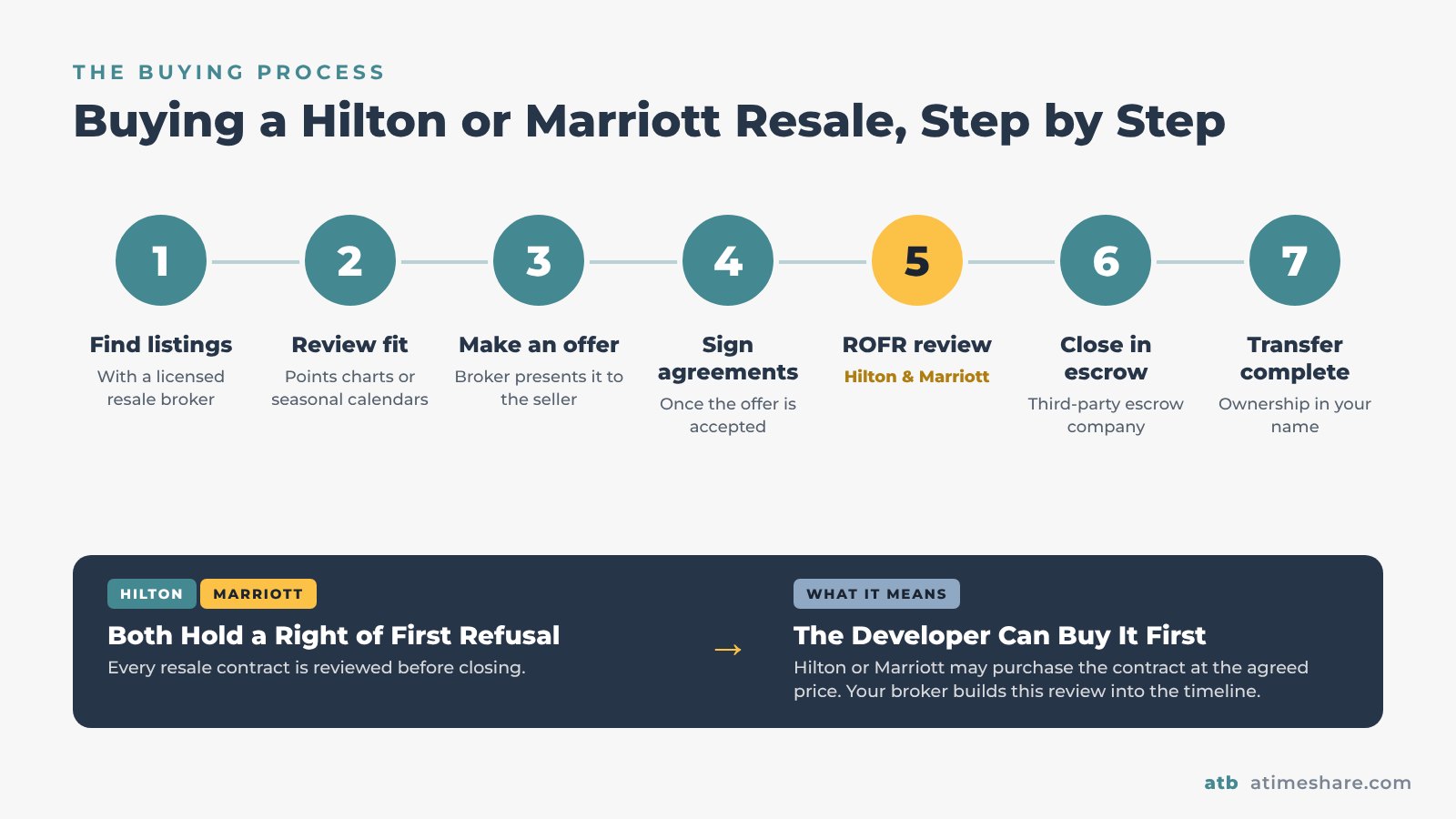
Both brands follow a similar broker-assisted process, and both Hilton and Marriott have a right of first refusal review before closing.
- Work with a licensed resale broker to identify listings matching your desired resort, points total, or deeded week (you can always verify a broker’s real estate license as an extra measure of precaution)
- Review points charts or seasonal calendars to confirm the ownership fits your travel plans
- Submit an offer, which the broker presents to the seller
- Sign purchase agreements once the offer is accepted
- For Marriott purchases, the contract moves through a right of first refusal review before closing; Hilton also uses a right of first refusal clause on resale transactions
- Close through a third-party escrow company that holds buyer deposits and coordinates the transfer with Hilton or Marriott directly
- Receive confirmation once the deed or beneficial interest has been transferred into your name
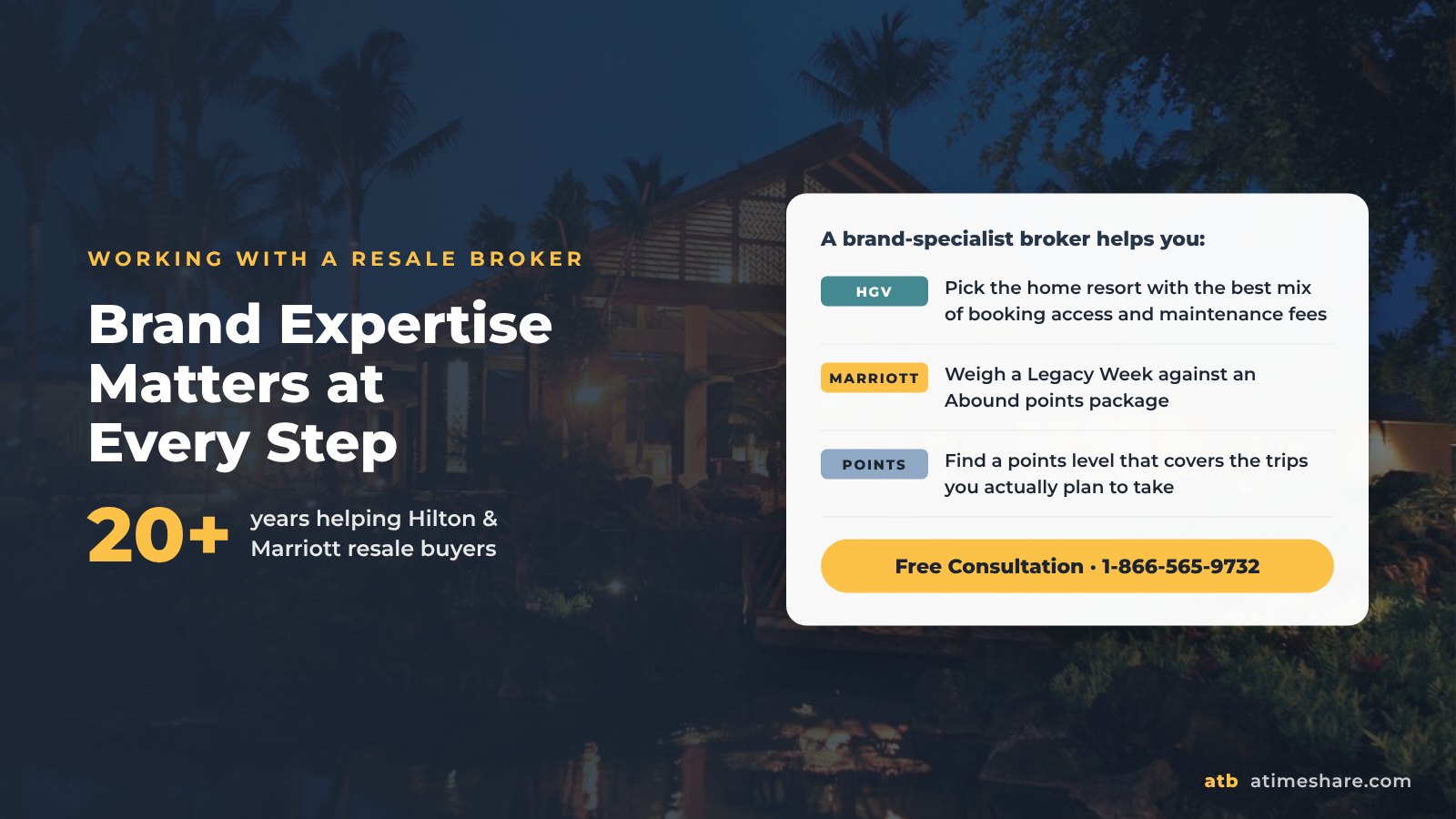
Working with a licensed resale broker who specializes in your chosen brand makes a meaningful difference at each stage of this process. Brokers familiar with HGV can advise on which home resort gives you the best combination of booking access and maintenance fee cost. Brokers familiar with Marriott can walk you through the difference between a Legacy Week and an Abound points package, and help you identify a points level that actually covers the trips you plan to take each year.
Marriott Vacation Club vs Hilton Grand Vacations: Which Brand Is the Better Fit for a Resale Buyer?
The right choice depends on how you prefer to vacation and how much flexibility you need from year to year.
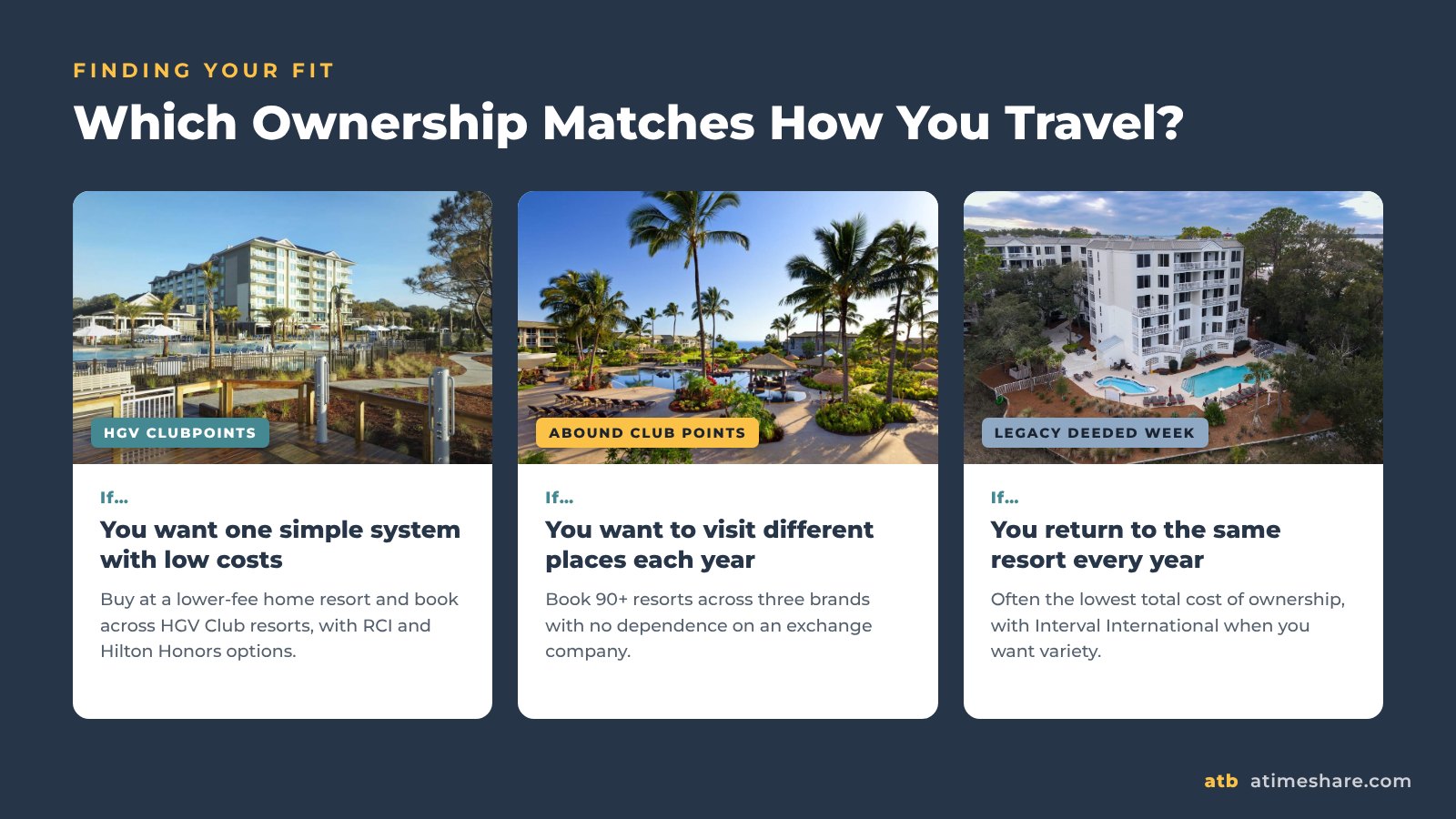
If you want a single, uncomplicated ownership that keeps costs low and still gives you access to a quality resort network, a Hilton ClubPoints resale at a lower-fee home resort is worth a close look. You will lose access to HGV Max, but the core system, booking across HGV Club resorts up to nine months out, using RCI for exchanges, and converting points to Hilton Honors, remains fully intact on the resale market.
If you want to travel to multiple destinations with no dependence on an exchange company, Marriott Abound Club Points on the resale market offer strong flexibility. The Abound network spans over 90 resorts across three brands, and resale buyers retain nearly all the same ownership rights as retail buyers, which is a meaningful advantage compared to other timeshare brands on the secondary market.
If you vacation at the same Marriott resort every year and are comfortable working within the Interval International exchange system when you want variety, a Legacy Deeded Week can deliver the lowest total cost of ownership, particularly if you find a listing under $1,000 for a quality resort and season.
Working With a Resale Broker
Whether you choose Hilton or Marriott, the resale buying process calls for a broker with direct experience in the brand you are purchasing. A Timeshare Broker has been helping buyers navigate Hilton and Marriott resales for over 20 years, and licensed agents are available for a free consultation to help you match your travel habits to the right ownership type and listing.
You can also browse Hilton ClubPoints listings, browse Abound Club Points listings, or browse Marriott Legacy Weeks listings to get a sense of what is currently available. Keep in mind that pricing changes as new listings are added and existing listings are sold, so the figures you see will reflect the market at the time of your search.

A Final Word
Even though we’ve positioned this article as Marriott Vacation Club vs Hilton Grand Vacations, each brand offers a great path to a lifetime of high-quality vacations. Hilton keeps things simple with a single points product and a well-organized booking system, while Marriott gives resale buyers two distinct options that range from the cost efficiency of Legacy Weeks to the network breadth of Abound Club Points.
Understanding what each ownership type actually delivers on the secondary market, rather than at the sales presentation, is the foundation of a sound buying decision. If you have questions about which product fits your situation, contact the team at A Timeshare Broker for a free consultation.